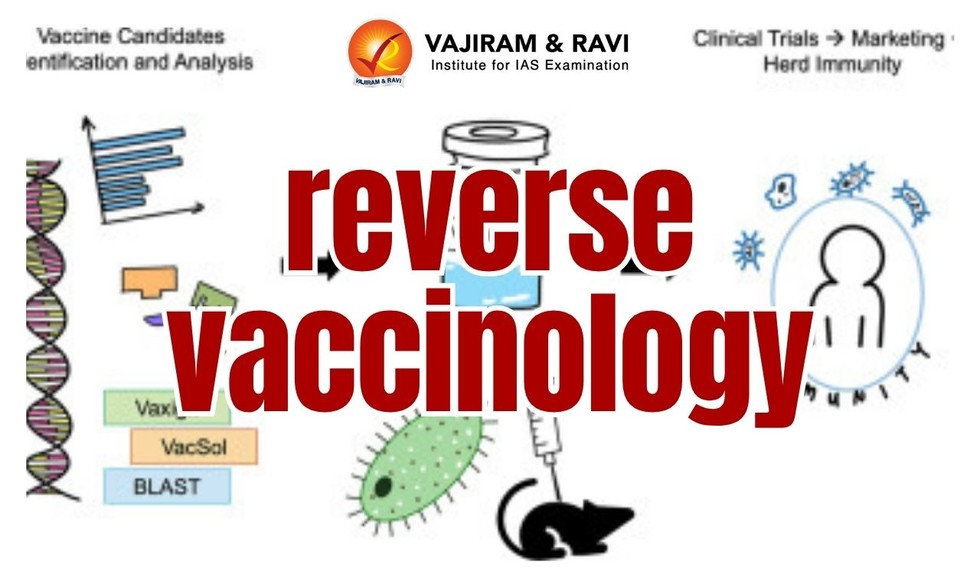
About Reverse Vaccinology:
- It is an emerging concept in the field of vaccine development.
- It is defined as an innovative approach to vaccine development that utilizes bioinformatics and computational analysis.
- It identifies potential vaccine targets within pathogen genomes, allowing for the modeling of epitopes and the creation of tailored vaccines for improved efficacy and safety.
- Reverse vaccinology is a term coined by Rino Rappuoli in 2000.
- He described it as a method for vaccine design that uses the information obtainable from whole-genome analysis.
- It was first applied to the development of a vaccine against serogroup B Neisseria meningitidis (MenB).
- The concept of reverse vaccinology has also successfully been applied to many other pathogens, for example, Bacillus anthracis, Streptococcus pneumonia, M. tuberculosis.
- Mechanism:
- Genome Sequencing: It involves the cloning and expression of all the proteins in an organism’s genome sequence that are predicted in silico to be surface exposed or secreted.
- Screening: Then each protein is screened, through high-throughput immunization.
- Laboratory Testing: Scientists make the chosen proteins in a lab and test them in animal models to see if they safely cause immunity.