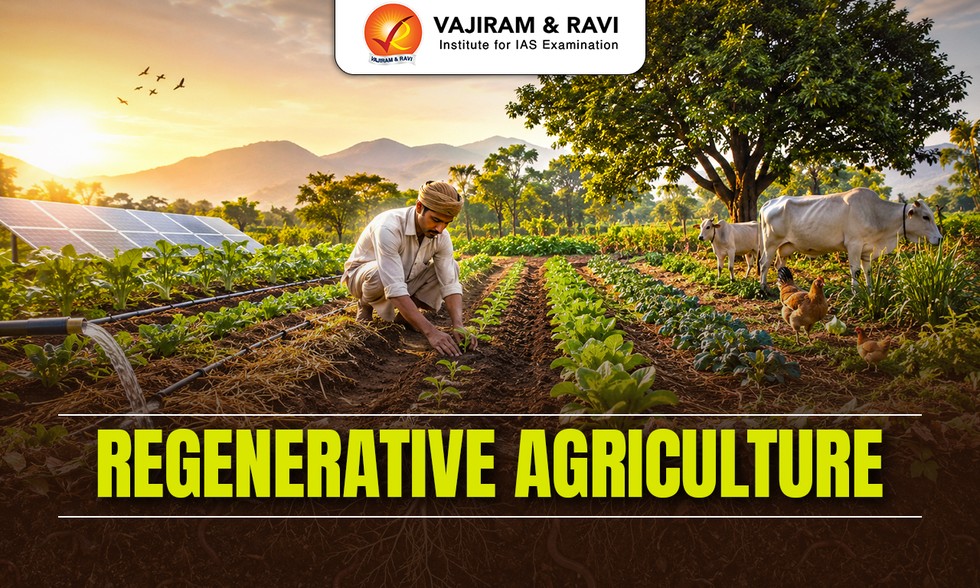
About Regenerative Agriculture:
- It is a holistic farming approach centred on restoring soil health and enhancing biodiversity.
- It focuses not merely on sustaining existing farming conditions, but on actively restoring soil health, improving biodiversity and strengthening farms against climate-related stresses.
- It is based on the following principles:
- Minimizing soil disturbance
- Protecting the living roots of perennial crops
- Maintaining soil cover
- Integrating Livestock
- Limiting the use of chemical inputs
- Enhancing biodiversity
- Popular Regenerative agricultural practices in India:
- Micro-irrigation: Drip and sprinkler systems deliver water closer to plant roots, reducing wastage and improving water-use efficiency.
- Natural farming: It uses on-farm biological inputs such as Beejamrut, Jeevamrut, GhanJeevamrut, Neemastra and Dashparni. It also encourages multi-cropping, mulching, cover cropping, minimal soil disturbance and livestock integration.
- Soil health management: Green manuring, cover cropping and mulching can add organic matter, protect soil from erosion, conserve moisture and support nutrient cycling.
- Integrated Farming Systems: Crops can be combined with livestock, fisheries, horticulture, agroforestry and apiculture. This diversification can reduce the risk of crop failure and create additional livelihood opportunities.
- Agroforestry: Integrating trees with crops can provide additional income while improving soil moisture, regulating local temperatures and storing carbon.