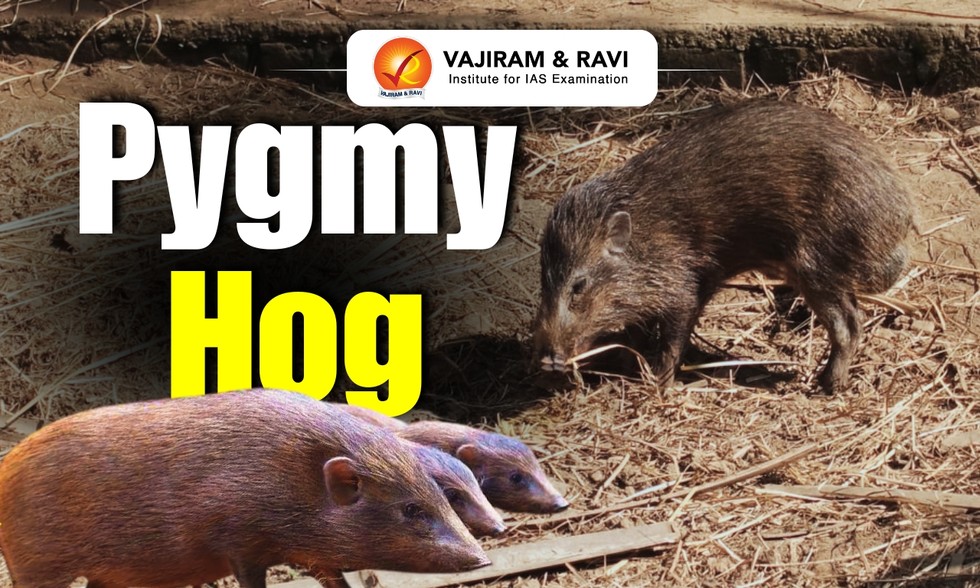
About Pygmy Hog:
- It is the smallest and rarest species of wild pig.
- It is one of the very few mammals that build its own home, or nest, complete with a ‘roof’.
- It is an indicator species as its presence reflects the health of its primary habitat.
- Habitat: It prefers undisturbed patches of grassland dominated by early succession riverine communities, typically comprising dense tall grass intermixed with a wide variety of herbs, shrubs and young trees.
- Distribution: Currently, they survive only in the grasslands of Assam’s Manas and Orang national parks.
- Diet: They feed on roots, tubers, shoots and ground vegetation, along with worms and other invertebrates.
- Ecological Role:
- Enhances Soil Quality: It digs for roots, tubers, wild fruits, termites, earthworms, eggs and other food sources found in grasslands which aerates the soil and enhances its quality.
- Disperses Seeds: It also helps dispersing seeds through its dietary and foraging habits.
- Conservation Status:
- IUCN: Critically Endangered
- The Wildlife Protection Act, 1972: Schedule I.
Integrated Development of Wildlife Habitats Scheme
- It is a centrally sponsored scheme provides financial assistance to states to protect certain species or wildlife areas through its recovery programme for critically endangered species and habitats.
- Components of the scheme:
- Support to Protected Areas (National Parks, Wildlife Sanctuaries, Conservation Reserves and Community Reserves)
- Protection of Wildlife Outside Protected Areas
- Recovery programmes for saving critically endangered species and habitat.