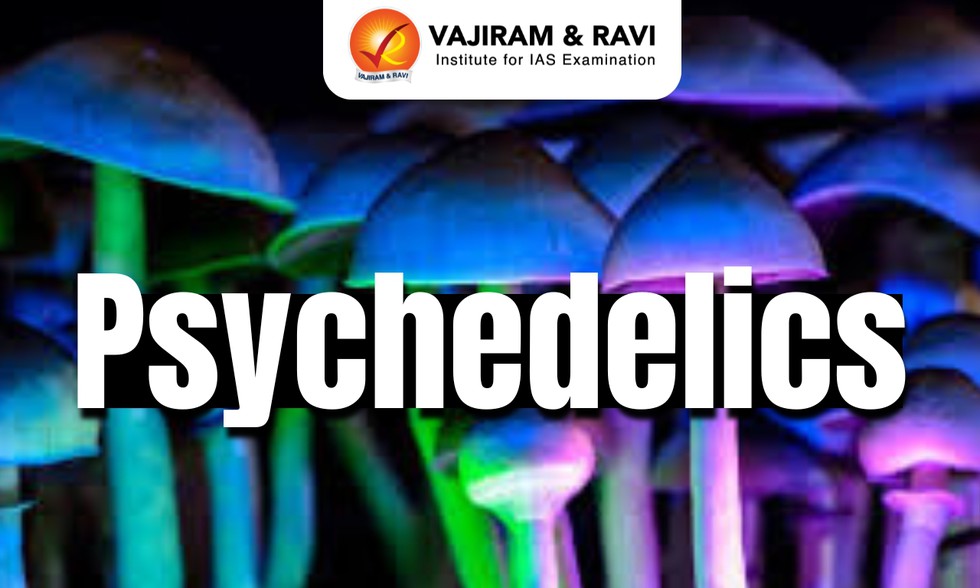
Recent study revealed that Psychedelics can temporarily ‘loosen’ the brain patterns that support the feeling of a ‘me’, allowing researchers to watch that system reorganise itself in real time.
About Psychedelics:
These are drugs that induce states of altered perception, behaviour, consciousness and thought, often with increased awareness of the senses.
Psychedelics are non-addictive and non-toxic. Compared to illicit drugs, psychedelics cause much less harm to the end user.
The term ‘psychedelic’ comes from two Greek words denoting mind or soul and manifesting.
It is a subset of psychotropic substances that can alter a person’s thoughts and perceptions, and elicit intense hallucinations.
Most psychedelics work by increasing the availability of serotonin—a mood stabilising hormone—in the brain by binding to serotonin receptors.
Regulation in India: In India, the Narcotic Drugs and Psychotropic Substances Act 1985 prohibits the use of psychedelic substances.
These are categorised into two broad categories
Classical psychedelics: These are thought to trigger hallucinations by activating a receptor called serotonin 5-HT, which is widely present in the human body, from the gastrointestinal tract to platelets to the nervous system. Examples: LSD, psilocybin and DMT
Nonclassical psychedelics: These psychedelics bind to varied receptors. Examples: ketamine and MDMA
Used for research: Five psychedelics are the subject of clinical research for use in treating mental health problems: psilocybin; lysergic acid diethylamide (LSD); 3,4-methylenedioxy-N-methamphetamine (MDMA); ketamine and N, N-dimethyltryptamine (DMT).
Dear Student,
You have still not entered your mailing address. Please enter the address where all the study materials will be sent to you. (If applicable).