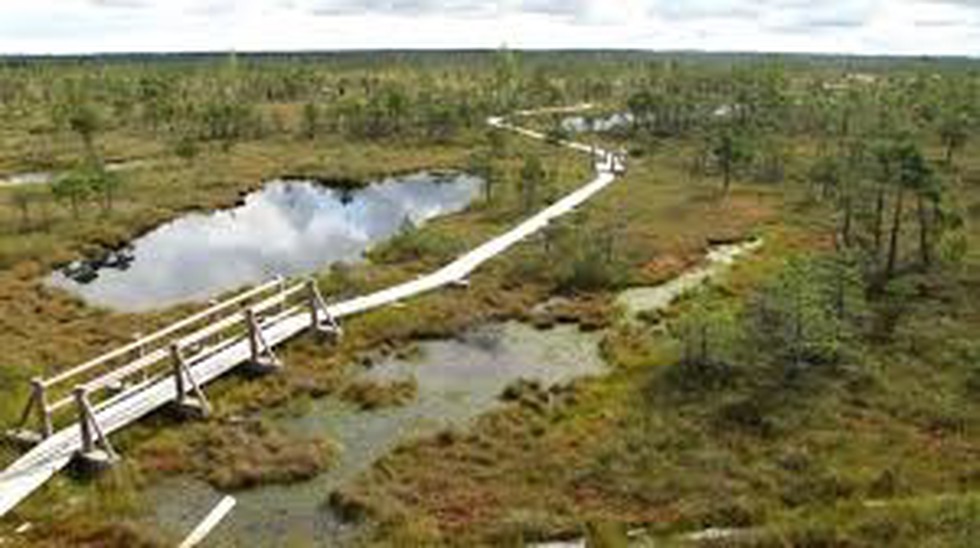
Researchers found that two lakes namely Mai Ndombe and Tumba in the Democratic Republic of Congo are releasing carbon that has been locked away for thousands of years in surrounding peatlands.
About Peatlands:
Peatlands are terrestrial wetland ecosystems in which waterlogged conditions prevent plant material from fully decomposing.
Consequently, the production of organic matter exceeds its decomposition, which results in a net accumulation of peat.
Peat, formed from the accumulation of dead plant material, does not decompose in a water-logged state but when it dries, the organisms that break down plant material revive and the carbon seeps back into the atmosphere.
In cool climates, peatland vegetation is mostly made up of Sphagnum mosses, sedges and shrubs and are the primary builder of peat,
In warmer climates graminoids and woody vegetation provide most of the organic matter.
The swamps and peatlands of the Congo Basin cover only 0.3% of the earth’s land surface, yet hold one-third of the carbon stored in its tropical peatlands.
Distribution: The majority of the world’s peatlands occur in boreal and temperate parts of the Northern Hemisphere.
Types:
Northern and temperate peatlands: Found especially, Europe, North America and Russia where they have formed under high precipitation-low temperature climatic regimes.
Tropical peatlands: Found in Southeast Asia, mainland East Asia, the Caribbean, Central America, South America, Africa, parts of Australasia and a few Pacific Islands.
Dear Student,
You have still not entered your mailing address. Please enter the address where all the study materials will be sent to you. (If applicable).