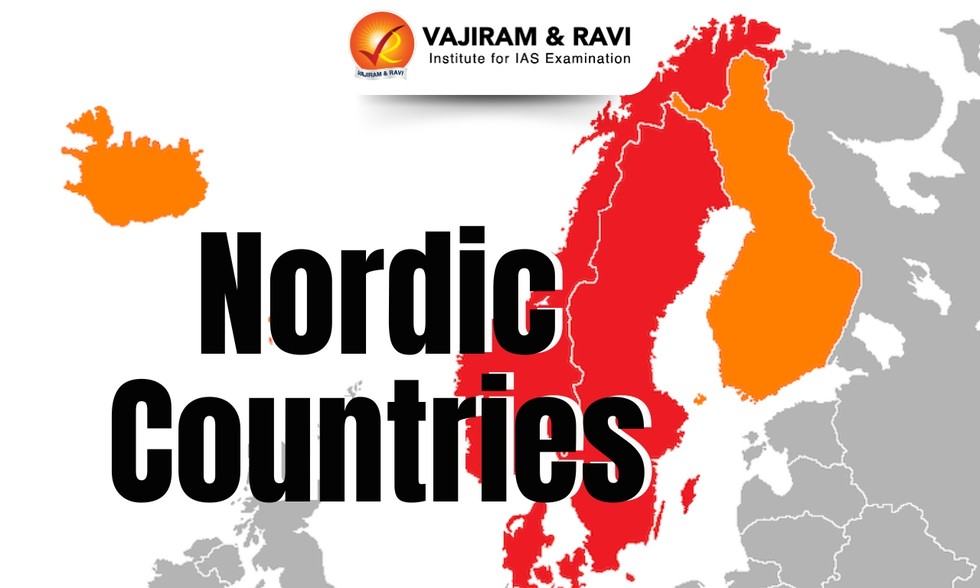
In the fourth leg of his visit, the Prime Minister will reach Norway for the 3rd India-Nordic Summit and bilateral engagements.
About Nordic Countries:
The Nordic countries, also known as the Nordic region, are a group of countries in northern Europe consisting of Denmark, Finland, Iceland, Norway, and Sweden.
The designation includes the Faroe Islands and Greenland, which are autonomous island regions of Denmark, and the Åland Islands, an autonomous island region of Finland.
The term is sometimes used interchangeably with Scandinavia, a peninsular region of northern Europe that serves as the geographic core of the Nordic countries.
Scandinavia is typically defined more restrictively, however, and refers primarily to Norway, Sweden, and Denmark.
Sweden is the largest and most populous of the Nordic countries. Iceland is the least populous. Denmark is the smallest.
The countries have many similarities in that they rank highly worldwide in such areas as education, civil liberties, quality of life, and economic competitiveness.
Language:
Most inhabitants of the Nordic region speak North Germanic languages (also called Nordic or Scandinavian languages): Danish, Norwegian, and Swedish, as well as Faroese and Icelandic.
Native non-Germanic languages include Greenlandic, Finnish, and Sami languages.
Political System:
Denmark, Sweden, and Norway are constitutional monarchies and parliamentary democracies.
Finland and Iceland are democratic republics.
Iceland's parliament, the Althing, is the oldest parliament in the world.
Cooperation:
There is close cooperation between the countries through the Nordic Council and the Nordic Council of Ministers.
Denmark, Sweden, and Finland are members of the European Union (EU).
Norway and Iceland are European Economic Area (EEA) members.
EEA includes EU countries and also Iceland, Liechtenstein, and Norway.
Dear Student,
You have still not entered your mailing address. Please enter the address where all the study materials will be sent to you. (If applicable).