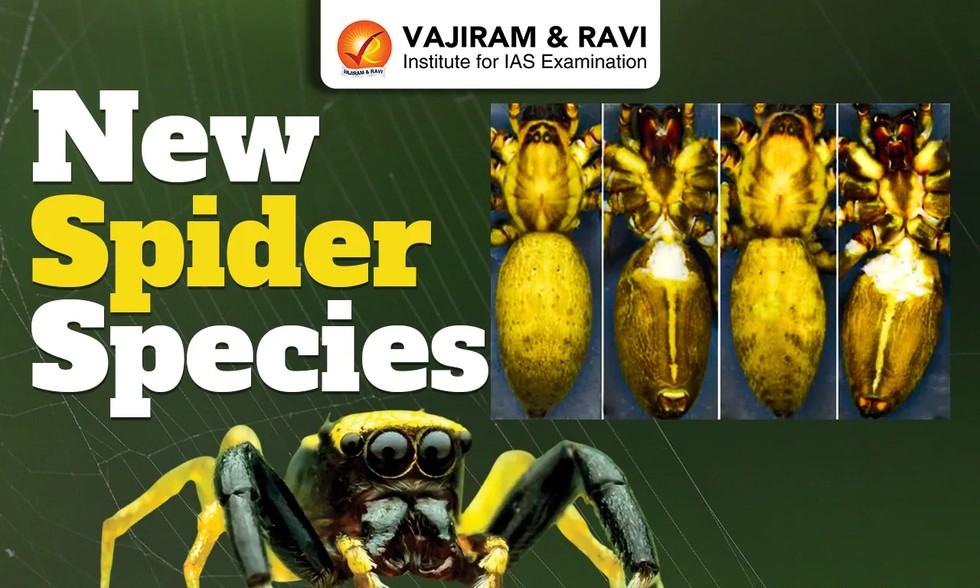
About Psechrus ntu and Psechrus phenshunyu:
- These are two newly discovered spider species from the genus Psechrus.
- Psechrus are a group of spiders belonging to the family Psechridae, commonly known for constructing large horizontal sheet webs in moist forest habitats.
- Both species were discovered in Nagaland and named after the local villages where they were first documented — Ntu and Phenshunyu.
- They exhibit several specialized anatomical characteristics associated with life in humid forest ecosystems:
- Elongated and dorsoventrally flattened body structures.
- Exceptionally long anterior legs adapted for environmental sensing.
- Fine sensory hair structures aiding vibration detection.
- Expanded web-building behavior suited to dense vegetation zones.
- Such traits are considered adaptive advantages for navigating dimly lit forest microhabitats where tactile and vibrational perception become essential for survival.
- The spiders construct expansive horizontal sheet-like webs that function both as prey-capture systems and environmental monitoring platforms.
- A male Psechrus himalayanus was observed sharing a web with Psechrus phenshunyu.
- This behavior, known as a heterospecific association, is extremely rare among spiders because most spider species exhibit territorial or cannibalistic tendencies.
Other Findings:
- The ZSI team also documented the occurrence of Psechrus himalayanus in Northeast India for the first time.
- This represents a major range extension from its previously known Himalayan distribution.
- ZSI researchers completed the first major taxonomic reassessment of Indian whip scorpions in over 100 years.
- Whip scorpions belong to the order Thelyphonida, an ancient and highly specialized arachnid lineage distinct from true scorpions.
- Despite their intimidating appearance, whip scorpions are non-venomous and harmless to humans.
- Whip scorpions possess several unique evolutionary adaptations:
- A long whip-like flagellum used for sensory navigation
- Enlarged pedipalps functioning as grasping appendages
- Acid-spraying defensive glands
- Strong nocturnal and burrowing behavior
- Their common nickname “vinegaroon” derives from the acetic acid-like spray they release when threatened.