
Nematode
Researchers from the Department of Aquatic Biology and Fisheries, University of Kerala, have discovered five new species of free-living nematodes in mangrove sediments along the Keralam coast.
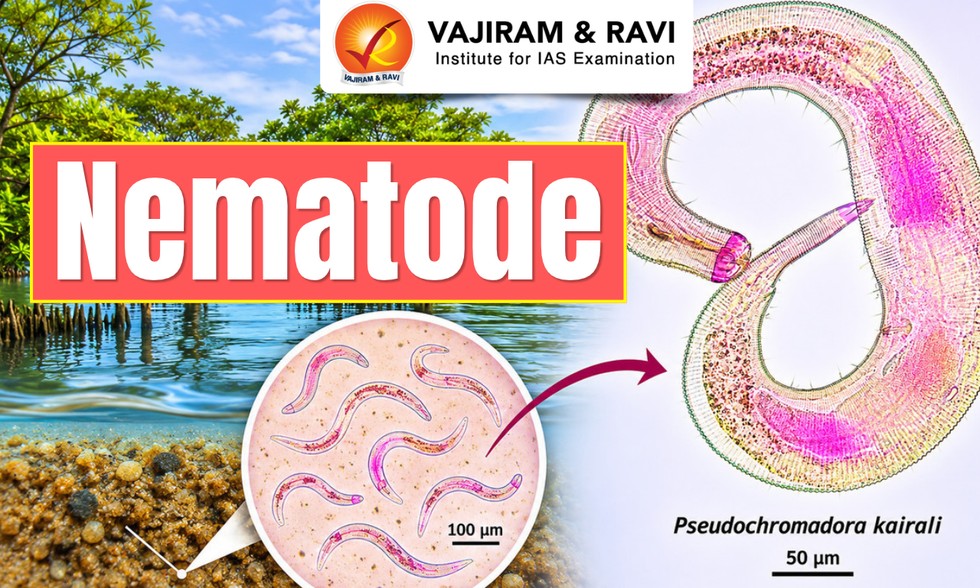
About Nematode:
- These are worms of the phylum Nematoda.
- They occur as parasites in animals and plants or as free-living forms in soil, fresh water, marine environments, and even such unusual places as vinegar, beer malts, and water-filled cracks deep within Earth’s crust.
- Features:
- Appearance: Nematodes are bilaterally symmetrical, elongate, and usually tapered at both ends.
- Some species possess a pseudocoel, a fluid-filled body cavity between the digestive tract and the body wall.
- Distribution: They have been reported from every continent on Earth and occur in deserts, swamps, the oceans, the tropics and Antarctica.
- Significance of marine nematodes:
- Nutrient Cycling: Breaking down organic waste and recycling essential nutrients back into the ocean.
- Sediment Health: Maintaining the stability and productivity of coastal sediments.
- Bio-Indicators: Serving as vital markers for environmental health and climate change impact.
New Nematode Species
- These were collected from mangrove-associated sediments of the Kerala coast.
- These new species are named as
- Pseudochromadora coronata, P. cryptica, and P. kairali from the mangrove forests of Sambranikodi, Kollam, and Pseudochromadora kandeli and P. longicaudata
- Some marine nematodes are free-living, meaning they are not parasites and generally measure a few millimetres in length.
- They abundantly inhabit marine and estuarine sediments, playing important ecological roles in organic matter decomposition and nutrient cycling.
Source: Five new species of free-living nematodes discovered in mangrove sediments along Keralam coast