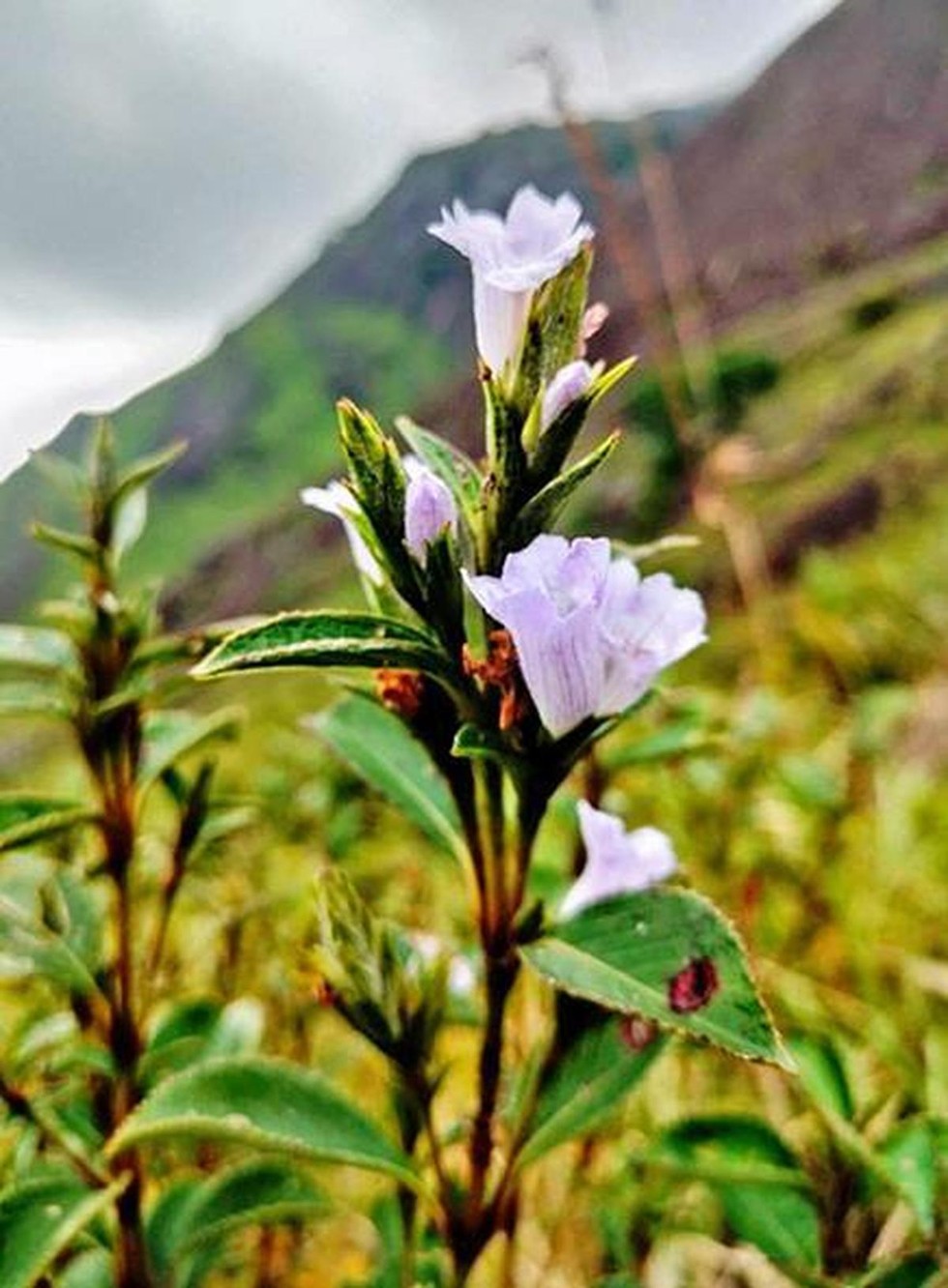
Recently, the Ministry of Environment, Forest and Climate Change (MoEFCC) has requested the National Green Tribunal to direct Keralam, Tamil Nadu, and Karnataka to submit an annual plan of operation incorporating a conservation action plan for Neelakurinji (Strobilanthes kunthiana).
About Neelakurinji:
It is the flowering shrub which blooms once in 12 years.
It belongs to the Acanthaceae family and was first scientifically described in the nineteenth century by Nees von Esenbeck.
It is semelparous with showy synchronous blooming and fruiting at every 12 years at the end of the life cycle, which has been reported since 1832.
Habitat: It is seen only in the high-altitude shola grassland ecosystems of five mountain landscapes of southwest India at an elevation of 1,340–2,600 m.
Distribution: Neelakurinji Flowers occur only in India, confined to five mountain landscapes of the Western and Eastern Ghats.
Conservation Status: Listed as Vulnerable under IUCN Red List Criteria A2c due to approximately 40% habitat loss.
Cultural significance:
Nilgiri Hills (Literally meaning the blue mountains), got their name from the blue flowers of Neelakurinji.
The Paliyan tribes (in Tamil Nadu) use it as a reference to calculate their age.
Threats: It is threatened mainly due to its fragile habitat in the montane high altitude grasslands that has been under pressure of conversion for tea and softwood plantations, and urbanization.
Dear Student,
You have still not entered your mailing address. Please enter the address where all the study materials will be sent to you. (If applicable).