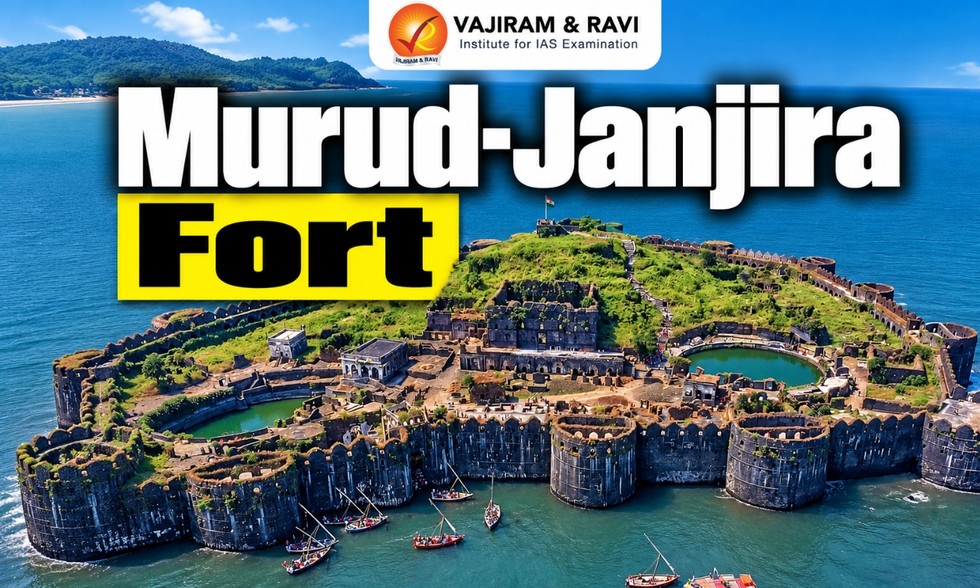
About Murud-Janjira Fort:
- It is an island fort located on an island off the coastal village of Murud, in the Raigad district of Maharashtra.
- It is surrounded by the Arabian Sea on all sides and is one of the strongest marine forts of India.
- History:
- The history of Murud Janjira Fort dates back to the 15th century, when the Siddi rulers established a powerful naval base along Maharashtra's western coast.
- The Siddis were the rulers of Murud-Janjira. They were people of African origin who had come to India many centuries ago.
- The name "Janjira" is believed to have originated from the Arabic word "Jazeera," meaning island.
- Initially constructed as a small wooden fort by local fishermen, it was later rebuilt into a massive stone fortress under the Siddis.
- The fort’s strategic location on the bustling maritime trade route connecting Broach, Daman, Diu, and Mangalore made it a vital hub for commerce and military operations.
- Over the centuries, Siddi alignment with Mughals provoked conflict with local kings, including Shivaji and his son Sambhaji, who attempted to scale the walls and tunnel to it, respectively.
- However, no outsider (including British, French, and Portuguese colonists) ever made it past the fort’s 12 m-high granite walls, which, when seen during high tide, seem to rise straight from the sea.
- Despite numerous attempts, its defenses remained unbreached, earning it the moniker “Unconquerable Janjira.”
- Architecture:
- The structure is built on a rock outcrop and has massive bastions and high protective walls.
- The fort was made by a mixture of lead, sand, and gul.
- The main gate of the fort facing Rajapuri on the shore is a huge structure. There is a small gate towards the open sea to escape from the enemies.
- Once it stood firm and robust in defence with roaring cannons, only a few of the large cannons remain in place today, and the largest of them is known as the Kalaal Bangdi.
- Earlier the fort was a full-fledged living place with all the necessary facilities like palaces, quarters for officers, a mosque, two small 18 m natural freshwater lakes, etc.
- There is also a deep well with cold and sweet water, a wonder of nature in the midst of the sea.