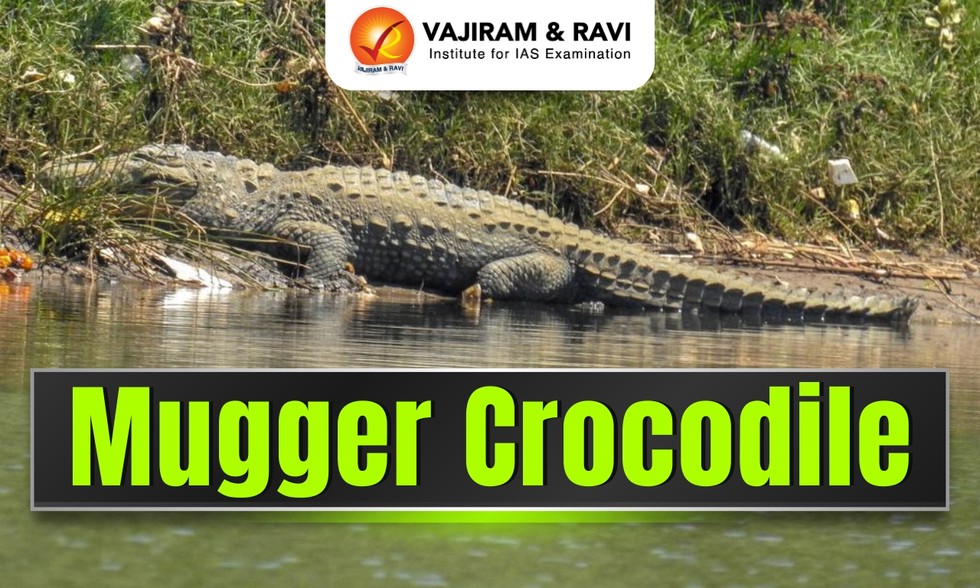
Recently, an investigation has revealed that a banned pesticide named Aldrin was responsible for the deaths of mugger crocodiles (Crocodylus palustris) in the Chandraloi river of Rajasthan’s Kota district.
About Mugger Crocodile:
It is a medium-sized crocodile and a member of the genus Crocodylus.
Appearance: It has the broadest snout among living crocodiles. It has a powerful tail and webbed feet. Its visual, hearing, and smelling senses are acute.
Habitat: It is found in a number of freshwater habitat types including rivers, lakes and marshes.
Distribution: It occurs in the Indian subcontinent as well as surrounding countries: Sri Lanka, Pakistan and Nepal.
It is a hole-nesting species, with egg-laying taking place during the annual dry season.
Diet: Muggers are primarily carnivorous, eating mostly fish, frogs, crustaceans, insects etc.
Threats: The main threats to this animal come from the destruction of its habitat and illegal hunting for its skin and for the alternative medicine market.
Conservation Status:
IUCN: Vulnerable
CITES: Appendix I
Wildlife Protection Act, 1972:Schedule I
What is Aldrin?
It is a pesticide from the organochlorine group.
It has been included in the list of banned pesticides by the Government of India because it persists in the environment for a long time and pollutes soil and water.
It gradually accumulates in the food chain and can have serious adverse effects on the nervous system of humans and wildlife.
Dear Student,
You have still not entered your mailing address. Please enter the address where all the study materials will be sent to you. (If applicable).