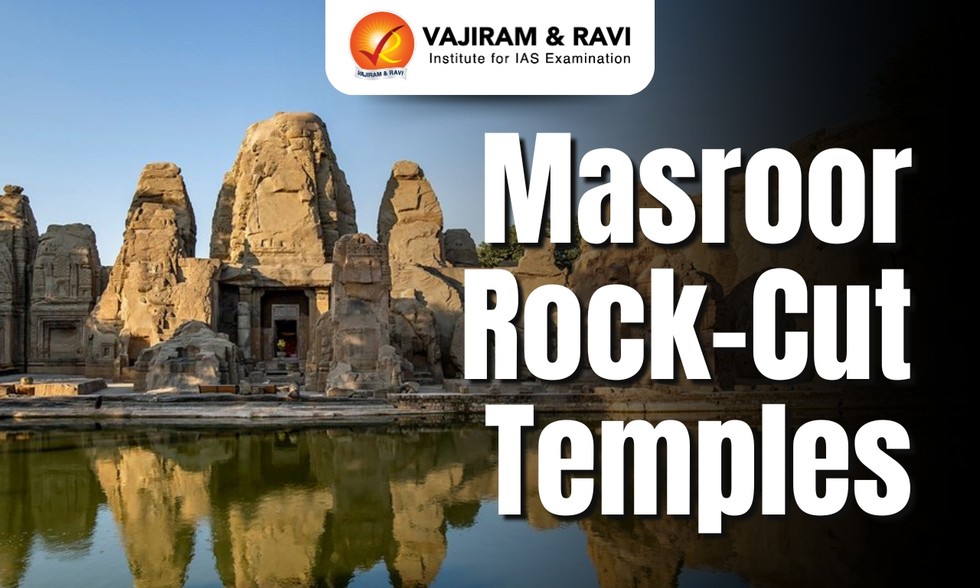
About Masroor Rock-Cut Temples:
- Masroor Rock-Cut Temples, also referred to as Masroor Temples, is an early 8th-century complex of rock-cut Hindu temples in the Kangra Valley of the Beas River in Himachal Pradesh.
- They are often referred to as the Ellora of Himachal and the Himalayan pyramid.
- History:
- Archaeological surveys say that they have been built around the 8th century, almost 1200 years ago, due to their resemblance to the “Gupta style of architecture” from the same period.
- However, there is no mention of the temple in any of the scriptures or historical records.
- The temple complex was first reported by Henry Shuttleworth in 1913, bringing it to the attention of archaeologists.
- They were independently surveyed by Harold Hargreaves of the Archaeological Survey of India in
- Architecture:
- The 15-monument temple complex resembles the North Indian Nagara architecture style and is dedicated to Lord Shiva, Lord Ram, Goddess Sita, and Lord Lakshmana.
- Unlike other Hindu temples in the country that face the east, this one faces northeast towards the Dhauladhar mountains.
- The temples were carved out of monolithic rock with a shikhara and provided with a sacred pool of water.
- The temple complex follows a symmetrically laid-out square grid.
- The main temple, with a square plan, is surrounded by smaller temples arranged in a mandala pattern.
- Three entrances adorn the temple, facing northeast, southeast, and northwest. Interestingly, evidence points towards a planned but unfinished fourth entrance, often overlooked in historical records.
- The Masrur Temples display elaborate reliefs portraying significant Vedic and Puranic deities.
- These reliefs are accompanied by captivating friezes that narrate ancient tales from Hindu texts.
- Much of the Masroor temple’s sculpture and reliefs have been lost. They were also quite damaged, most likely from earthquakes.