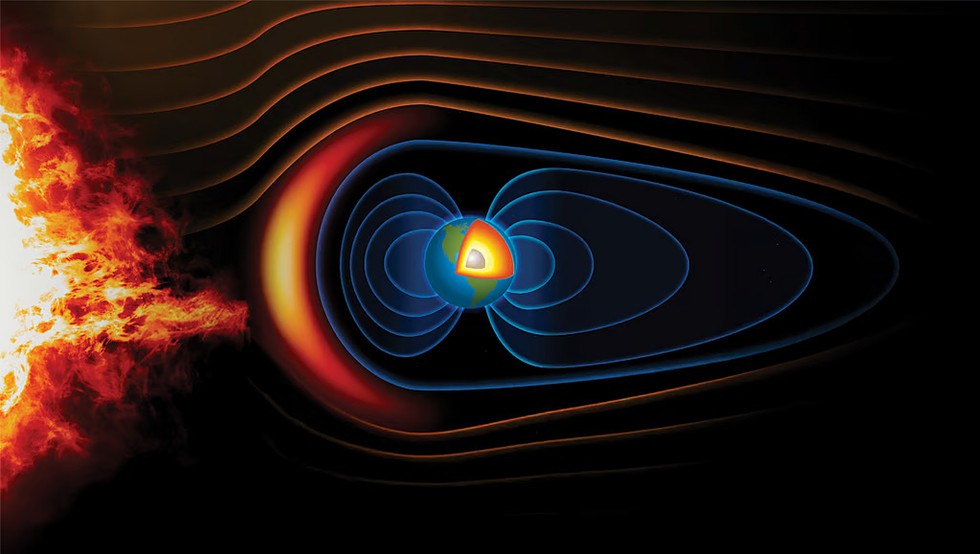
What is Earth's Magnetic Field?
- The Earth’s magnetic field acts as an invisible shield that protects the planet from harmful cosmic and solar radiation.
- It is generated 2,900 km below the surface in the liquid outer core through electric currents arising from the movement of molten iron, powered by heat from the inner core and Earth’s rotation.
- This field forms a protective bubble that extends into space, shielding the atmosphere and biosphere.
Magnetic Reversals vs. Excursions
- A magnetic reversal occurs when the magnetic north and south poles swap places and retain that position for over 100,000 years (e.g., Brunhes-Matuyama reversal 780,000 years ago).
- A geomagnetic excursion is a temporary flip in polarity lasting a shorter time and is 10 times more frequent than reversals (e.g., Laschamps excursion 41,000 years ago, where strength dropped to 5%).
- Over the last 83 million years, Earth has witnessed 183 magnetic reversals.
- Causes of Magnetic Fluctuations: Driven by turbulent fluid dynamics in the outer core, influenced by Earth’s rotation and heat from the inner core. Clockwise flow maintains normal polarity; anticlockwise shifts trigger reversals.
- Current Trends and Observations: 10% Weakening of magnetic field strength over the past 200 years; at current rates, it could vanish in 1,500–1,600 years. The North Magnetic Pole drifts 35 km/year toward Siberia, while the South Pole shifts 5 km/year, reflecting core turbulence.
Research Methodologies
- Satellites and Observatories: Provide real-time data (e.g., ESA’s soundtracks converting magnetic signals into audio).
- Historical data: Ship logs (since 1590) and archaeological artifacts (e.g., ancient pottery) preserve geomagnetic signatures.
- Geological samples: Lava rocks, lake/ocean sediments (e.g., Bagwalipokar excursions in Uttarakhand) reveal past field behavior.
- Cosmogenic isotopes: Beryllium-10 and carbon-14 in ice cores spike during weak fields (e.g., doubled during Laschamps).