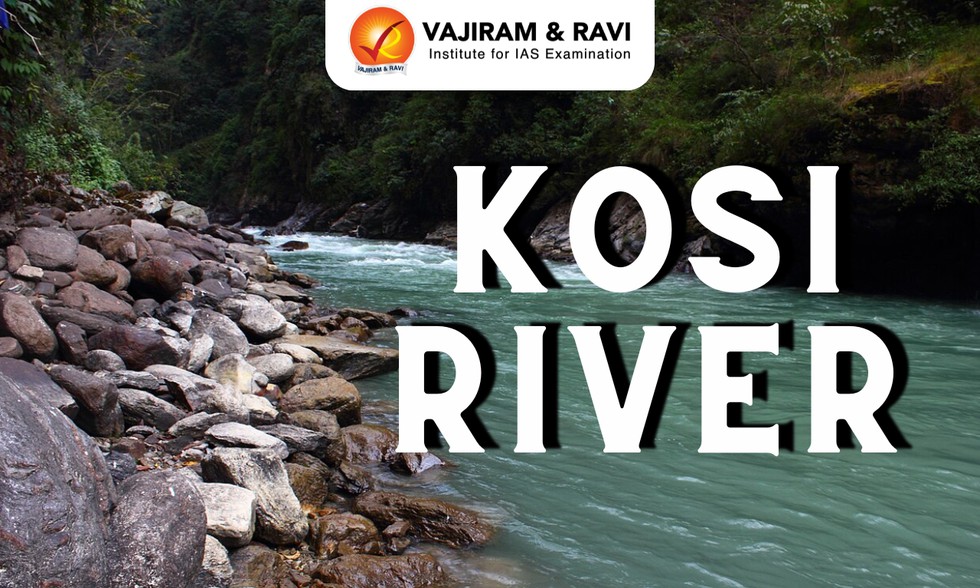
Over the past 200 years, the Kosi River has shifted its path westward by over 100 kilometres.
About Kosi River:
It is a transboundary river which flows through China, Nepal, and India.
It is a prominent tributary of the Ganges, also known as "Sorrow of Bihar" because of the big floods it can cause, especially in the Indian state of Bihar.
Course:
The river Kosi is formed by the confluence of three streams, namely the Sun Kosi, the Arun Kosi, and the Tamur Kosi, all of which have their origin in the Himalayan region of Nepal and Tibet.
About 48 km north of the Indian-Nepalese frontier, the Kosi is joined by several major tributaries and breaks southward through the Siwalik Hills at the narrow Chatra Gorge.
The river then emerges on the great plain of northern India in Bihar state on its way to the Ganges River, which enters south of Purnea after a course of about 724 km.
Over the last 250 years, the Kosi has shifted its course over 100 kilometres from East to West and the unstable nature of the river is attributed to the heavy silt it carries during the monsoon season.
Corn (maize) is extensively cultivated on the sandy soils of the Kosi’s basin.
Tributaries: It has seven major tributaries: Sun Koshi, Tama Koshi or Tamba Koshi, Dudh Koshi, Indravati, Likhu, Arun, and Tamore or Tamar.
Dear Student,
You have still not entered your mailing address. Please enter the address where all the study materials will be sent to you. (If applicable).