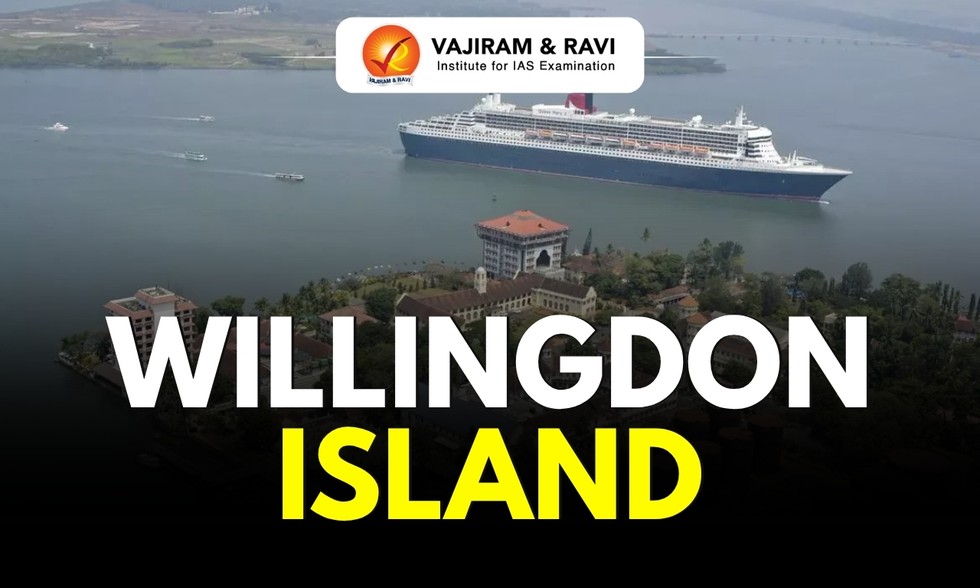
About Willingdon Island:
- It is a man-made island in the city of Kochi, Kerala.
- It is one of the largest man-made islands in India.
- History:
- The island was created in 1936 by dredging the soil from the Vembanad Lake, which is the largest lake in Kerala.
- The aim was to create a deep-water port that could accommodate large ships and vessels and to improve the trade and commerce of Kochi.
- The project was initiated by Lord Willingdon, the British Viceroy of India, who also gave his name to the island.
- Designed and created by the harbour engineer Sir Robert Bristow, it is today a massive commercial centre in Kochi.
- Apart from its commercial significance, Willingdon Island also hosts several important institutions and facilities.
- The Southern Naval Command of the Indian Navy is headquartered here.
- It is also home to the Central Institute of Fisheries Technology and the Port of Kochi.
- The island is connected to the mainland Kochi by the Venduruthy Bridge.
Who was Lord Willingdon (1931 – 1936)?
- He was a British administrator who served in several high offices of the British Empire.
- Positions held in India:
- Governor of Bombay: 1913–1918
- Governor of Madras: 1919–1924
- Viceroy and Governor-General of India: 1931–1936
- He served as 22nd Viceroy and Governor-General of India from 1931 to 1936.
- Major events during his tenure:
- He succeeded Lord Irwin.
- His tenure coincided with the Civil Disobedience Movement led by Mahatma Gandhi.
- Gandhi attended the Second Round Table Conference (1931) in London shortly after Willingdon assumed office.
- After the failure of the conference, the Civil Disobedience Movement resumed, and the British government adopted a stricter policy toward nationalist leaders.
- The Communal Award (1932), introduced by British Prime Minister Ramsay MacDonald, was announced during his tenure.
- The Poona Pact (1932) between Mahatma Gandhi and B. R. Ambedkar also took place during this period.
- The Government of India Act, 1935, an important constitutional reform that introduced provincial autonomy, was enacted during his tenure.