
Key Facts about Tangail Saree
The Madras High Court recently held that Bangladesh's petition challenging India's Geographical Indication (GI) registration of the 'Tangail Saree of Bengal' is maintainable.
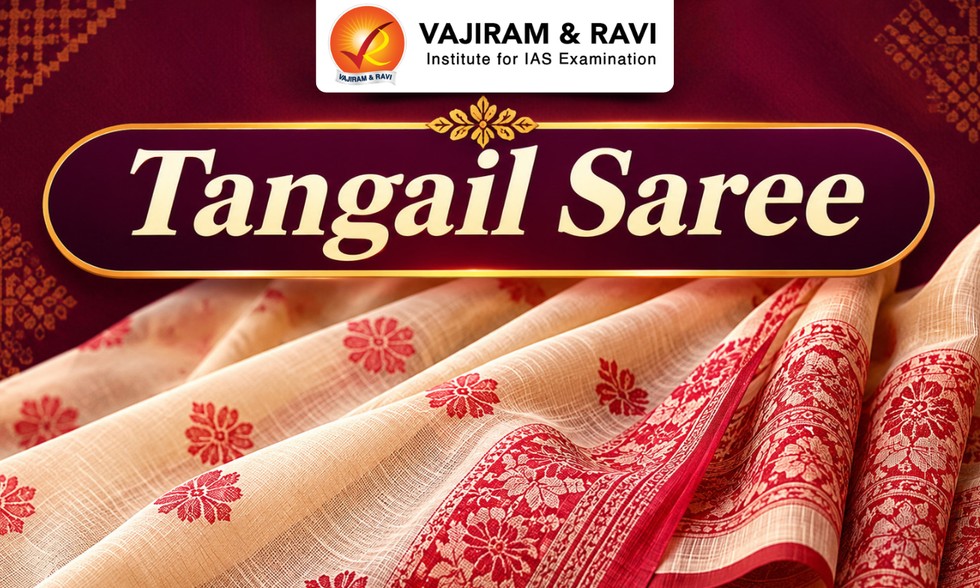
About Tangail Saree:
- It is a traditional handwoven cotton saree from Bengal.
- It began in the Tangail district in present-day Bangladesh, and after Partition, many of its weavers settled in Phulia and nearby villages of West Bengal, so today it is woven on both sides of the border.
- Features:
- Tangail sarees are characterized by their fine texture, detailed designs and local patterns, making each piece a work of art that reflects local social and cultural practices.
- It has a fine body scattered with small woven motifs called buti and a decorated border and pallu.
- A typical Tangail feels light, smooth, and slightly crisp, because the yarn is fine and the cloth is starched during weaving.
- The body is often a soft or pale colour, the buti are spaced across it, and the border and pallu carry most of the colour and pattern.
- Silk, tussar, and blended versions exist too, but cotton is what most people mean by a Tangail.
- The sarees hold strong cultural value and are often worn during major festivals, weddings, and celebrations.
- Men generally lead the main weaving process, including designing, dyeing the yarn, and crafting the fabric using the traditional handloom.
- The Tangail Saree of Bengal was officially granted a Geographical Indication (GI) tag by the Indian GI Registry in Chennai, registered in favor of the West Bengal State Handloom Weavers Co-Operative Society Limited.
- However, the registration triggered opposition in Bangladesh, which subsequently secured a separate GI registration for 'Tangail Sari' under its domestic law in 2024.
- In 2025, UNESCO also inscribed Bangladesh's traditional saree weaving art of Tangail on its Representative List of the Intangible Cultural Heritage of Humanity.
Source: Madras High Court agrees to hear Bangladesh’s challenge to India’s GI tag for Bengal's Tangail saree