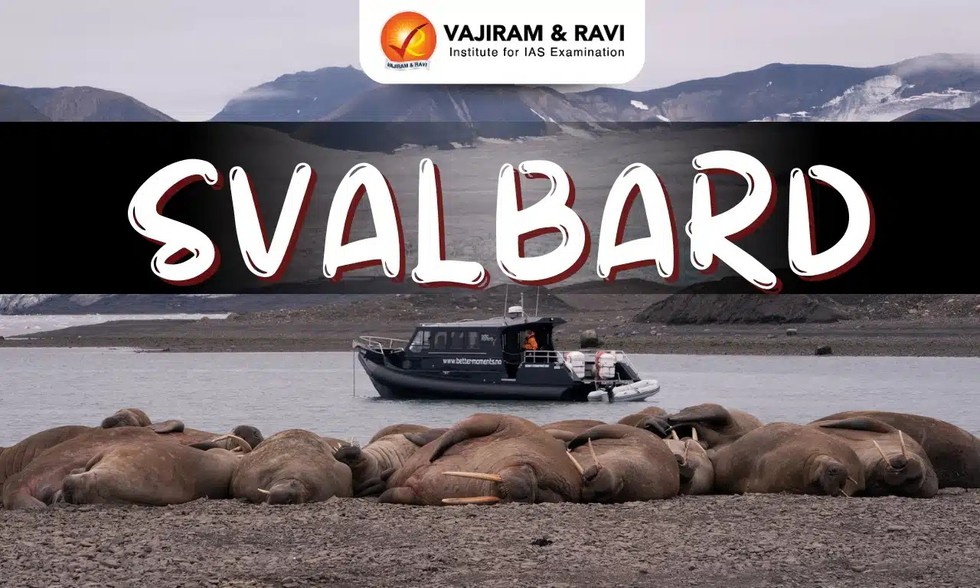
A significant new discovery recently emerged in the Arctic, with scientists spotting an unexpected gathering of walruses on the remote shores of Svalbard, a wild stretch of land nestled between mainland Norway and the North Pole.
About Svalbard:
It is a Norwegian archipelago that is situated in the Arctic Ocean, to the north of the European mainland.
It is located about halfway between the North Pole and the northern part of Norway.
It is the northernmost place in the world with a permanent population.
Discovery: It was discovered by the Dutch explorer Willem Barentsz in 1596.
The Svalbard Treaty, 1920 established Norwegian sovereignty over the Svalbard Islands.
Spitsbergen is the largest and most populous
The island is bounded by the Arctic Ocean, the Greenland Sea, and the Norwegian Sea.
The Svalbard Global Seed Vault is also located on Spitsbergen. It is the largest backup facility for the world’s crop diversity.
Climate: The archipelago features an Arctic climate, although with significantly higher temperatures than other areas at the same latitude.
Due to its location in the northern part of the Arctic Circle, the Svalbard Islands experience the midnight sun during the summer months and polar night during the winter months.
Vegetation consists mostly of lichens and mosses; the only trees are the tiny polar willow and the dwarf birch.
Svalbard is a breeding ground for many seabirds, and also features polar bears, reindeer, the arctic fox, and certain marine mammals.
Key Facts about Walrus:
It is a large mammal that lives in the cold Arctic seas of Europe, Asia, and North America.
It is closely related to the seals.
The walrus can be told apart from seals by the two large upper teeth, called tusks, that stick down from its mouth.
Scientific Name: Odobenus rosmarus.
There are two subspecies: the Atlantic walrus (Odobenus rosmarus rosmarus) and the Pacific walrus (O. rosmarus divergens).
Features:
The walrus has a stocky body and a rounded head.
It has flippers instead of legs. Its mouth is covered with stiff whiskers.
The skin is wrinkled and grayish brown. A thick layer of fat below the skin, called blubber, keeps the walrus warm.
Dear Student,
You have still not entered your mailing address. Please enter the address where all the study materials will be sent to you. (If applicable).