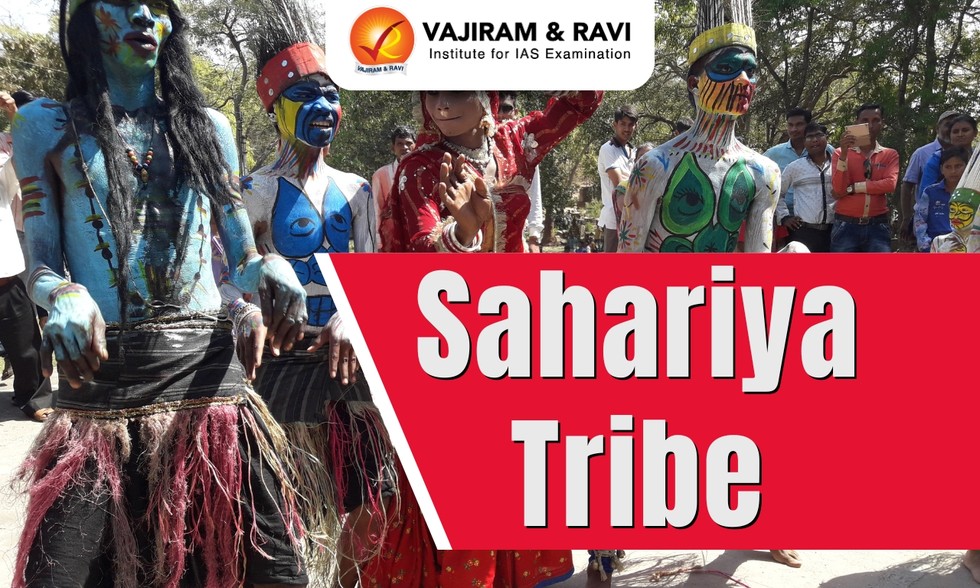
The President recently interacted with Cheetah Mitras and members of the Sahariya tribe at Kuno National Park in Madhya Pradesh’s Sheopur district.
About Sahariya Tribe:
It is one of the Particularly Vulnerable Tribal Groups (PVTG).
They are also called by the names Seher, Sair, Savar, Saonar, Sahra,
They live on the margins, in the forests and villages of Madhya Pradesh and Rajasthan.
They mostly live in a distinct settlement called ‘Seharana’ which is generally a cluster of houses.
The houses are made of some stone boulders, and the roofing is also made of stone slabs – locally called Patore.
In some villages, mud structures are also constructed.
Language: While the Sahariyas have lost their original language, they speak the local dialects of the regions they inhabit.
Religion: They practice Hinduism infused with veneration of local deities like Bhavani, Gond Devta, and Bijasur, alongside animistic elements tied to their jungle-dwelling heritage.
The Saharia are divided into five sub-tribes: the Jati, Arsi, Muli, Kindal, and Kumbi.
This classification is based primarily on occupation.
The Jati are farmers; the Arsi are weavers; the Muli are iron workers; the Kindal are basket makers; and the Kumbi are potter
They are known for their dance, the Saharia Swang, which is performed during the month of Holi.
The dance is performed to the beats of the dhol, nagari, and matki.
It features a male dressed in female attire who dances around the male performers.
Livelihood:
They are predominantly forest dwellers and make their living from forest produce, additionally cultivating small plots of land and work as landless labourers.
They are particularly skilled in making catechu from khair trees.
Dear Student,
You have still not entered your mailing address. Please enter the address where all the study materials will be sent to you. (If applicable).