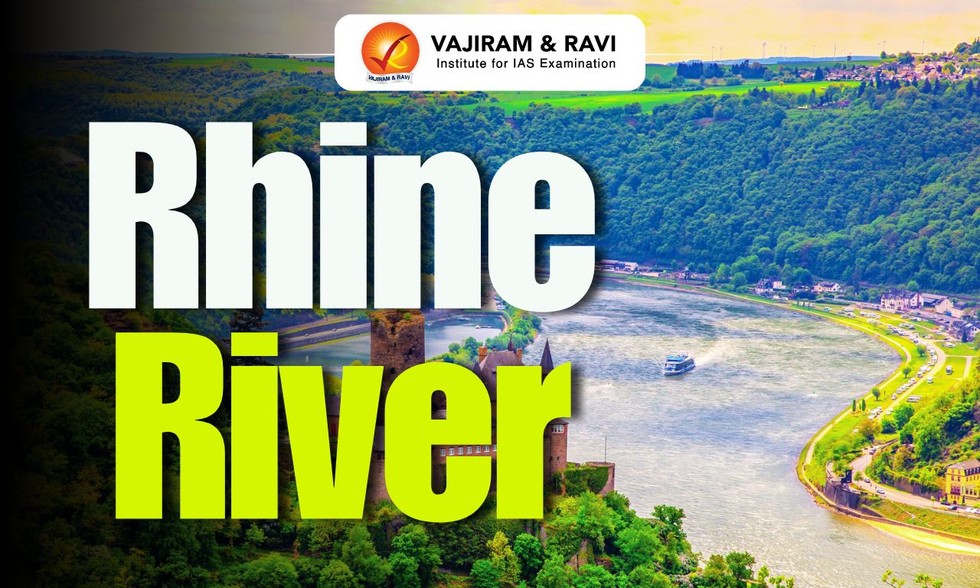
The water levels in the Rhine River, a major highway for European freight traffic, recently sank below the record set in October 2018.
About Rhine River:
It is a river and waterway of Western Europe.
It is the 12th longest river in Europe and the longest in Western Europe.
It is called different names depending on the country it flows through. It is called Rhein in Germany, Rhine in France, and Rijn in the Netherlands.
Course:
Origin: In the Alps of eastern Switzerland, two mountain streams run together to form the Rhine.
It flows through six countries–Switzerland, the Principality of Liechtenstein, Austria, Germany, France, and the Netherlands before flowing into the North Sea at Rotterdam, Netherlands.
The Rhine forms a natural border between Germany and France.
The Rhine, alongside the Danube, formed the Roman Empire’s northern inland frontier.
The Rhine served as a formidable German border during World War II, a defensive barrier to Allied troops.
Tributaries: Some of the notable tributaries include Aare, Tamina, Moselle, Erft, Rein da Tuma, Plessur, Rotach, and Wiese.
The Rhine Falls near Schaffhausen in Switzerland is Europe's largest waterfall.
The Upper Middle Rhine Valley in Germany is famous for its castles, vineyards, and the legendary Lorelei Rock.
The major cities along the Rhine include Basel (Switzerland),Cologne, Bonn, Duisburg, Mainz, Leverkusen, and Neuss (Germany), Strasbourg (France), and Rotterdam and Utrecht (Netherlands).
It is Europe’s most important commercial waterway, channeling the flow of trade among Switzerland, France, Germany, and the Netherlands.
It facilitates industrial transportation and supports industrial production, with about 20% of the world’s chemical industries manufacturing along the river.
Dear Student,
You have still not entered your mailing address. Please enter the address where all the study materials will be sent to you. (If applicable).