A mechanical artwork created in 1775 to portray the eruption of Italy's Mount Vesuvius has been recently brought to life for the first time.
About Mount Vesuvius:
It is an active volcano located on the west coast of Italy near Naples, in the Gulf of Naples.
It stands about 4,200 feet (1,280 meters) high, but its height changes after each major eruption.
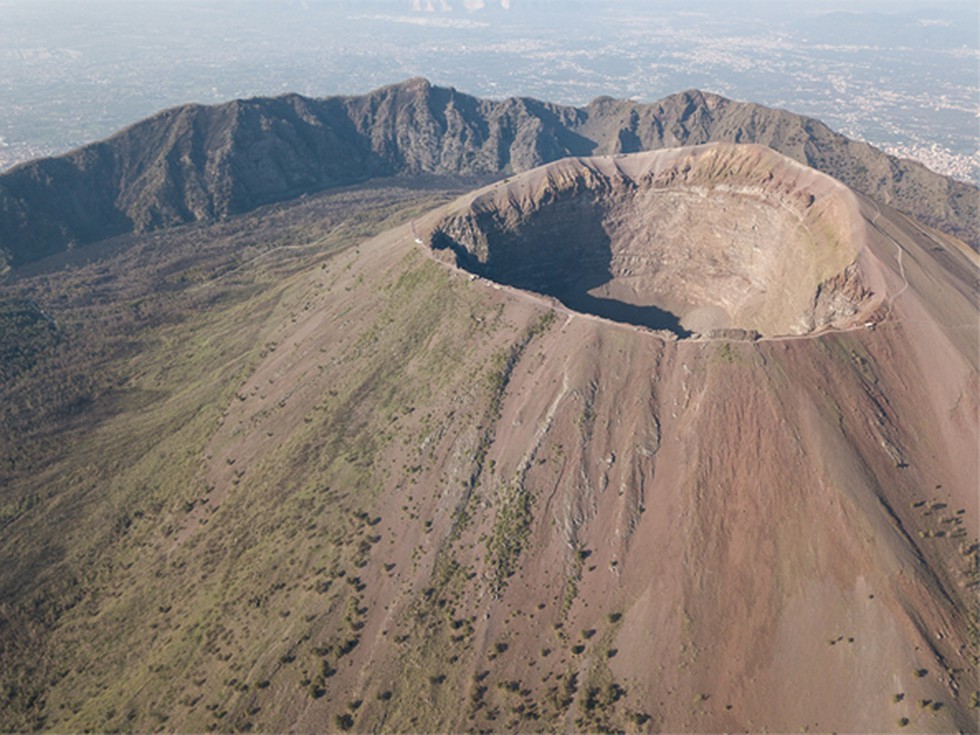
It is a composite stratovolcano, made up of pyroclastic flows, lava flows, and debris from lahars that accumulated to form the volcanic cone.
A high ridge known as Mount Somma partly surrounds the main cone of Vesuvius.
The area between the ridge and the cone is known as Valle del Gigante (Giant’s Valley).
At the top of the cone is a large crater. It is about 1,000 feet (300 meters) deep and 2,000 feet (600 meters) across.
As part of the Campanian volcanic arc, it formed over the subduction zone created by the collision of the Eurasian and African tectonic plates.
This subduction zone stretches the length of the Italian peninsula and is the source of other volcanoes, such as Etna and Stromboli.
Mount Vesuvius is the only active volcano in mainland Europe.
Its eruptions typically involve explosive eruptions as well as pyroclastic flows.
It is one of the most dangerous volcanoes on the planet.
It is most famous for the 79 AD eruption, which destroyed the Roman cities of Pompeii and Herculaneum.
The cities were engulfed in pyroclastic flows—superheated, high-density clouds of volcanic gas, ash, and rock that flow downslope at hundreds of kilometers per hour.
Dear Student,
You have still not entered your mailing address. Please enter the address where all the study materials will be sent to you. (If applicable).