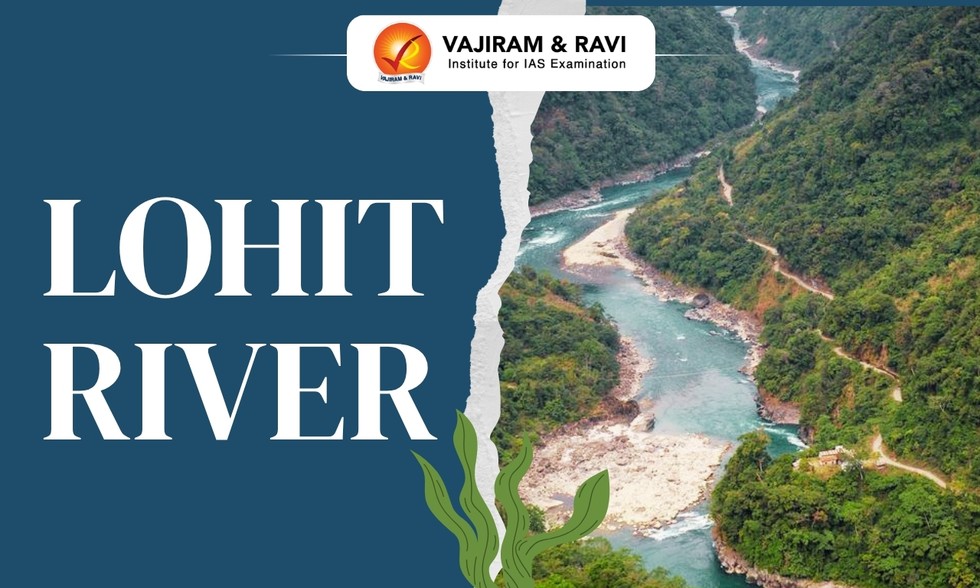
About Lohit River:
- It is a major tributary of the Brahmaputra River in northeastern India.
- Course:
- It originates in eastern Tibet, in the Zayal Chu range, and surges through Arunachal Pradesh for 200 kilometers, joining the Brahmaputra in Assam.
- Entering India via the Anjaw district, it traverses deep valleys, dense forests, and remote tribal areas.
- Some of the densest tropical jungles all over India are found in this area.
- The river is fast, fierce, and unpredictable, descending rapidly from the Tibetan plateau into narrow gorges.
- By the time it reaches India, it is a powerful force, crashing over boulders and carving through the Mishmi Hills.
Why is the Lohit Called the River of Blood?
- Geologically, the Lohit Valley and Mishmi Hills are rich in laterite, an iron-heavy soil that gives the river a reddish hue during high flow after rainfall.
- Rivers Dau, Dalai, and Tidding are its major tributaries on the right bank, and river Lang is the major tributary on the left bank.
- Being the principal river of Arunachal Pradesh, it largely contributes towards the drinking water supply, agriculture, and energy needs.
- A Hindu pilgrimage known as Parshuram Kund is nestled on the lower reaches of Lohit.