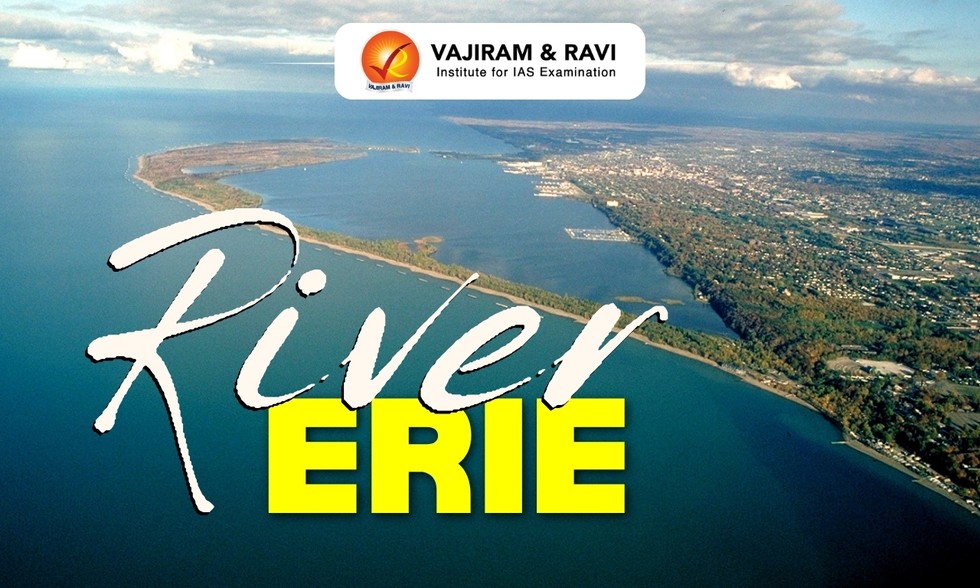
About Lake Erie:
- It is the fourth-largest and the southernmost of the five Great Lakes in North America.
- It is also the warmest, shallowest, and smallest of the Great Lakes by volume.
- However, it is the most productive of the region’s lakes.
- It was named after the Erie Indians, who once lived on its shores.
- It forms the boundary between Canada (Ontario) to the north and the United States to the west, south, and east.
- It is located just below Lake Huron and bordered by Lake Ontario and Lake Michigan.
- Globally, Lake Erie is the 11th largest lake by both surface area and volume.
- The lake’s principal tributary rivers are the Detroit (carrying the discharge of Lake Huron), Huron, and Raisin rivers of Michigan, etc.
- Lake Erie drains into Lake Ontario via the Niagara River.
- Its western end contains several islands. The largest is Pelee Island.
- Lake Erie has four major ports—Detroit, Michigan; Cleveland, Ohio; Toledo, Ohio; and Buffalo, New York.
- It is an important link in the Saint Lawrence Seaway. The seaway connects the Great Lakes with the Atlantic Ocean.
- Biodiversity:
- Lake Erie hosts numerous species, including many Lake Erie water snakes.
- There are also millions of mayflies and several bird species, including common red-breasted mergansers, grebes, loons, ring-billed gulls, diving ducks, and herring gulls.
- Lake Erie has the most abundant fish species of all the Great Lakes due to plenty of plankton and mild temperature, accounting for more than half of the Great Lakes’ fish population.
Key Facts about the Great Lakes:
- The Great Lakes are five large lakes in eastern North America.
- They are Lakes Superior, Michigan, Huron, Erie, and Ontario. Together the Great Lakes the largest connected area of fresh water on Earth.
- Lake Michigan is the only one of the Great Lakes that is completely within the United States.
- The other four form a natural border between Canada and the United States.
- Lake Superior is the largest and the deepest of the Great Lakes. Lake Ontario is the smallest.