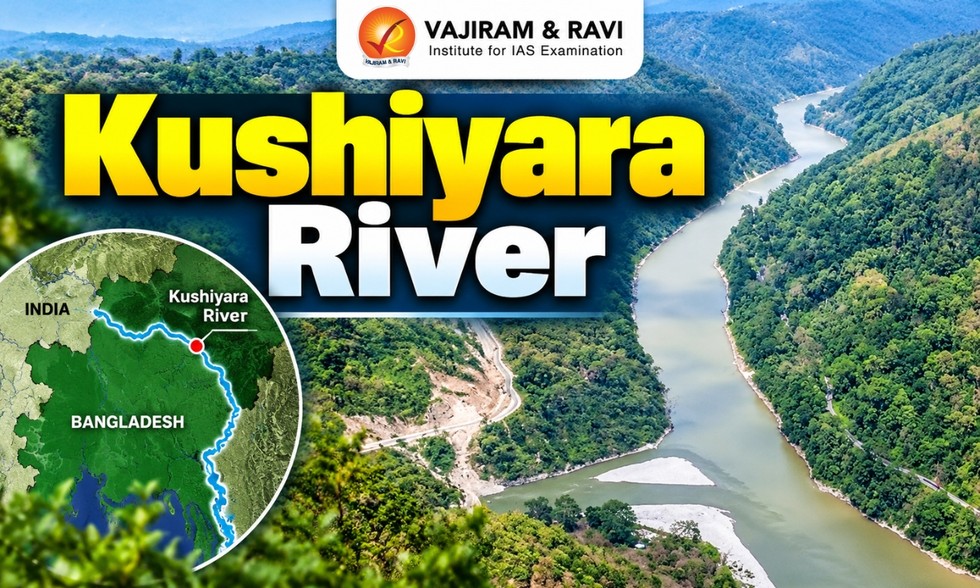
The banks of Kushiyara River, which separates India and Bangladesh along the Sribhumi district, came alive recently as thousands of devotees gathered on both sides of the international border for the immersion of Durga idols on Vijayadashami.
About Kushiyara River:
It is a transboundary river between India and Bangladesh.
It is a distributary of the Barak river.
Course:
It originates at the India-Bangladesh border as a branch of the Barak River, known as the Amlshid bifurcation point.
Flowing westward, the River forms the boundary between Assam, India, and the Sylhet District of
Along its course, it passes through towns like Zakigonj, Sylhet, and Karimganj, Assam, before entering entirely into the Beanibazar Upazila of Bangladesh.
The river then meanders southwestward, passing several villages and eventually joining the Meghna River.
The Kushiyara River receives contributions from various significant tributaries, including:
Juri River (from the east)
Manu River (Monu River) (from the south)
Itakhola River
In 2022, India and Bangladesh signed the Kushiyara River Water Agreement, which represents a critical turning point in their water-sharing relationship.
This is the first water-sharing agreement between India and Bangladesh since the historic Ganga Water Treaty of 1996.
The agreement aims to address the problems of seasonal water scarcity and flooding in both Assam, India, and Sylhet, Bangladesh.
This allocation ensures adequate water for irrigation in Sylhet’s dry-season (Boro) rice cultivation.
The water of Kushiyara will be channelled through the Rahimpur Canal project in Sylhet.
Unlike the Teesta River dispute with West Bengal, the Kushiyara agreementdoes not require state-level approval from Assam.
Dear Student,
You have still not entered your mailing address. Please enter the address where all the study materials will be sent to you. (If applicable).