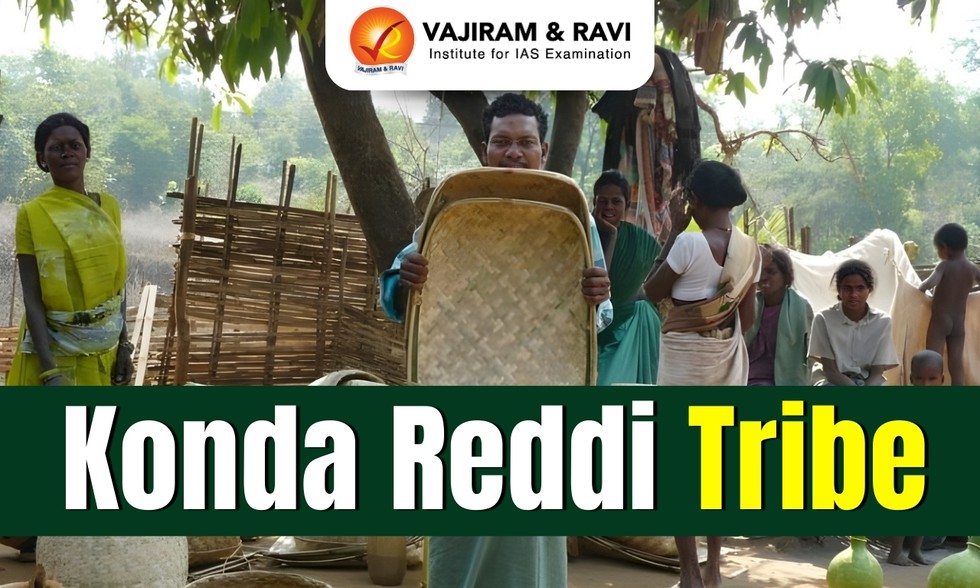
At least 38 thatched houses belonging to members of the Konda Reddi tribe have been gutted in a fire mishap reportedly due to a short circuit at Sarlanka village in Prathipadu Mandal in Kakinada district, Andhra Pradesh, recently.
About Konda Reddi Tribe:
Konda Reddis is a Particularly Vulnerable Tribal Group (PVTG) inhabiting the banks situated on either side of the Godavari River in the hilly and forest tracts of the East and West Godavari and Khammam districts of Andhra Pradesh.
Language: Their mother tongue is Telugu in its purest and chaste form and a unique accent.
Religion:
The primary religion practiced by the Konda Reddi is Folk Hinduism, characterized by local traditions and cults of local deities worshiped at the community level.
Their main festivals are Ugadi, Akshade, and Dussehra.
Family and Marriage:
The family is patriarchal and patrilocal.Monogamy is a rule, but polygamous families are also found.
Marriage by negotiations, by love and elopement, by service, by capture, and by exchange are socially accepted ways of acquiring mates.
Political Organization:
They have their own institution of social control called ‘Kula Panchayat’.
Each village has a traditional headman called ‘Pedda Kapu’.
The office of the headman is hereditary, and the headman is also the Pujari (priest) of the village deities.
Livelihood:
They are primarily shifting cultivators and largely depend on the flora and fauna of forest for their livelihood.
They eat a variety of tubers, roots, leaves, wild fruits,
They collect and sell non-timber forest produce like tamarind, adda leaves, myrobolan, broomsticks etc., to supplement their meagre income.
They largely cultivate jowar, which is their staple food.
The Konda Reddi tribe’s way of life largely revolves around the cow, which is a source of sustenance for them.
These tribal people are aggressive in the cultivation of commercial crops such as cashew, niger, chilli, and cotton under the Podu cultivation method.
The tribe has adopted a unique circular-shaped architecture for housing. The houses, built with circular mud walls and thatched roofs, resemble the Bhunga architecture of Gujarat’s Kachchh region.
Dear Student,
You have still not entered your mailing address. Please enter the address where all the study materials will be sent to you. (If applicable).