
Key Facts about Iwo Jima
Japan's Meteorological Agency recently detected an underwater volcanic eruption off the shores of Iwo Jima.
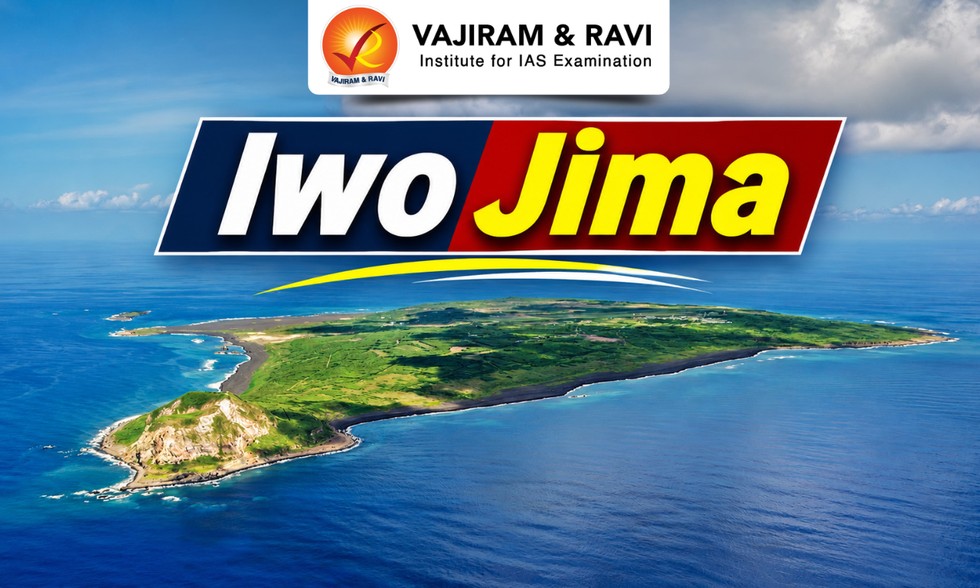
About Iwo Jima:
- Iwo Jima, now officially known as Iwo To, is a small Japanese island in the Pacific Ocean.
- The island is volcanic in origin, and the name Iwo Jima means ‘’Sulfur Island’’ in Japanese.
- The island was created by the twin cones of a volcano rising from the sea, and it still sits on an active volcano that frequently has small eruptions.
- Iwo Jima is part of a chain of three islands called the Volcano Islands.
- It is characterized by its rugged terrain, including the prominent Mount Suribachi (an extinct volcano).
- Although the island had a small population historically, it was evacuated during World War II and has since seen limited civilian presence, as it is primarily controlled by the Japanese military.
- Access to the island is restricted, with visits allowed only under specific conditions.
- Additionally, recent volcanic activity has raised concerns, with eruptions leading to the emergence of a new island named Niijima.
- It is known for its significant role in World War II, particularly during the intense 36-day Battle of Iwo Jima.
Key Facts about Battle of Iwo Jima:
- It was fought during World War II between the United States and Japan.
- It took place from 19 February to 26 March 1945.
- The battle was part of the US strategy of advancing towards Japan through the Pacific.
- The US military operation was code-named Operation Detachment.