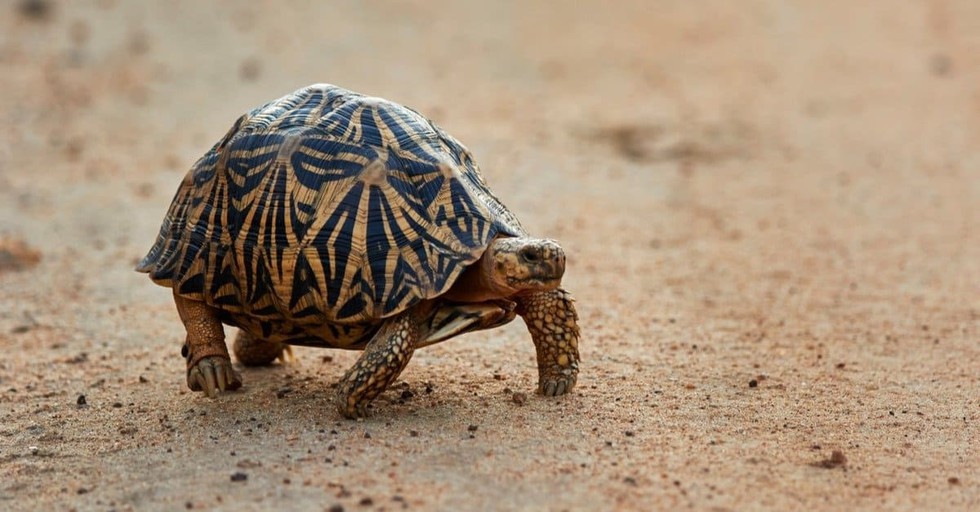
About Indian Star Tortoise:
- It is a medium-sized terrestrial tortoise.
- Scientific Name: Geochelone elegans
- Their name comes from the star-like pattern on their shell.
- These patterns act as camouflage by helping to break up the shell outline so that it more easily blends into its surroundings.
- Distribution: It is native to India, Pakistan and Sri Lanka where it inhabits dry areas and scrub forest.
- Conservation Status:
- IUCN Red List: Vulnerable
Key Facts about Amrabad Tiger Reserve:
- It is located in the Nallamala hills of the Eastern Ghats in Telangana.
- It is one of the largest tiger reserves in India.
- It was originally part of the larger Nagarjunasagar-Srisailam Tiger Reserve before the bifurcation of Andhra Pradesh and Telangana in 2014.
- The reserve is renowned for its rugged terrain, deep valleys, and dense forests.
- Within the reserve lies the historic Nagalapuram fort.
- The Krishna River and its perennial streams originating within the reserve contribute to the water supply of major reservoirs such as the Srishailam Dam and Nagarjunsagar Dam.
- The Chenchu tribe is one of the major tribal communities that live in the ATR.
- Flora:
- It is characterized by dry deciduous forests, primarily made up of sal, teak, bamboo, and acacia trees.
- The forest is rich in medicinal plants and shrubs, which have long been used by local tribes for traditional remedies.
- Fauna:
- Apart from tigers, the reserve supports a range of other big cats, such as leopards and wild cats, along with herbivores like sambar deer, chital (spotted deer), nilgai (blue bull), wild boar, and the Indian bison (gaur).
- Many bird species have been identified in this region. Some important groups include Eagles, Pigeons, Doves, Cuckoos, Woodpeckers, Drongos, etc.