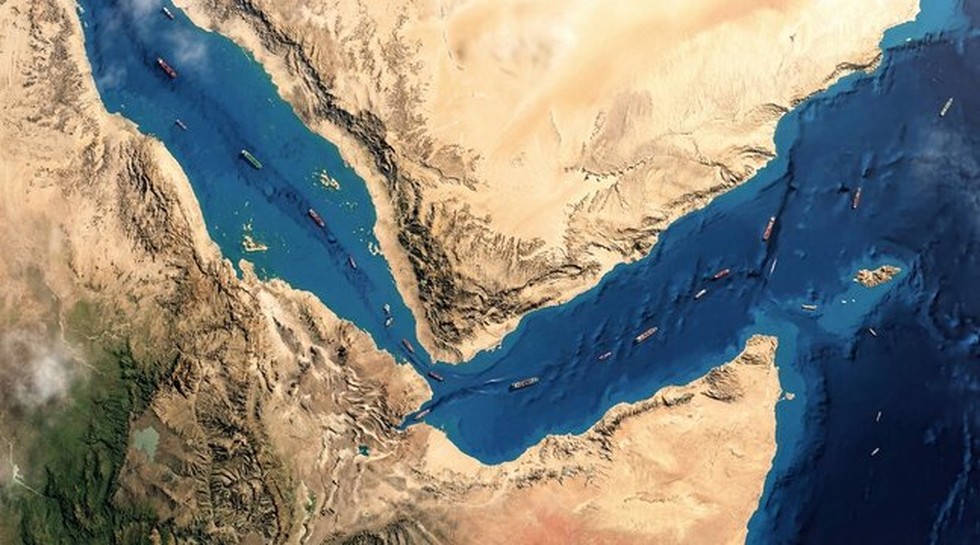
Yemen’s coast guard recently reported that unidentified armed men hijacked an oil tanker off the coast of Shabwa province and diverted it towards the Gulf of Aden near Somali waters.
About Gulf of Aden:
It is an extension of the Indian Ocean, located between the Arabian Peninsula (north) and the Horn of Africa (south).
It connects to the Red Sea in the West and the Arabian Sea in the East via the Strait of Bab el Mandeb.
The gulf is named after “Aden,” a port city on Yemen’s coast.
It is one of the largest natural harbors in the world.
It is bounded to the south by Somalia and the Socotra Islands (part of Yemen), north by Yemen,east by the Arabian Sea, and west by Djibouti.
The gulf is connected to the Somali Sea to the south by the Guardafui Channel.
In the west, it narrows into the Gulf of Tadjoura, near Djibouti.
The dominant relief feature is the Sheba Ridge, an extension of the Indian Ocean ridge system, which extends along the middle of the gulf.
The Gulf of Aden is strongly influenced by the upwelling of cool, nutrient-rich waters during the southwest and northeast monsoons and is characterized by a prevailing high-energy climate.
Compared to the neighbouring Red Sea, the Gulf of Aden has a lower saline content.
The Gulf is filled with numerous islands belonging to Yemen and Somalia.
Some of the major cities near the gulf include Aden, Mukalla, Ahnwar, Balhaf, Berbera, Bosaso, and Djibouti City.
Major Ports: Aden in Yemen, and Berbera and Bosaso in Somalia.
It is also a critical part of the Suez Canal shipping route, which connects the Red Sea and the Mediterranean Sea.
An estimated 11% of seaborne petroleum passes through the Gulf of Aden en route to the Mediterranean or Arabian Seas.
Dear Student,
You have still not entered your mailing address. Please enter the address where all the study materials will be sent to you. (If applicable).