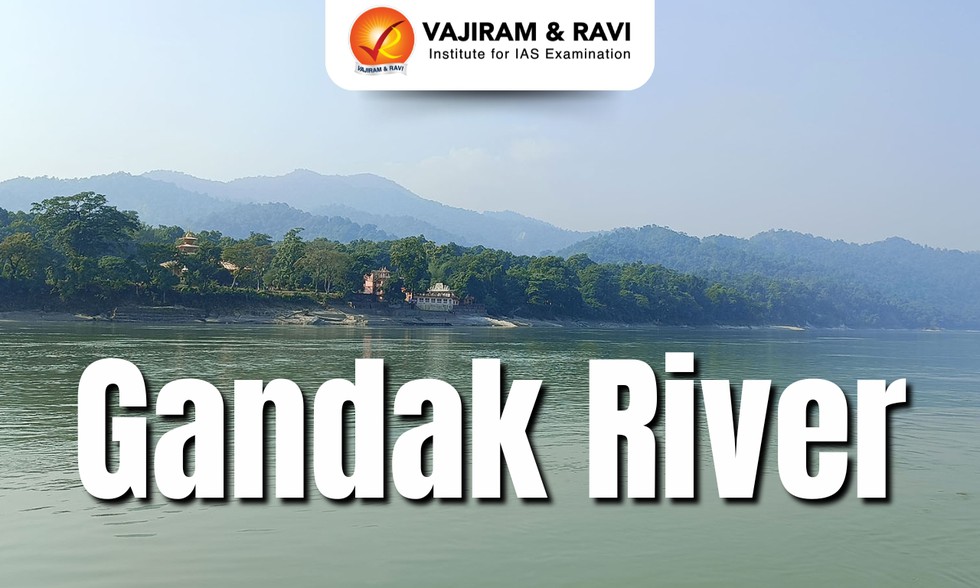
The Gandak River has emerged as the second major river after the Chambal with the highest number of gharials, also known as fish-eating crocodiles.
About Gandak River:
The Gandak River, also known as the Narayani and Gandaki, is one of the major rivers in Nepal and a left-bank tributary of the Ganges in India.
It is mentioned in the ancient Sanskrit epic Mahabharata.
Course:
It originates to the north of Dhaulagiri Mountain in Tibet near the Nepal border.
After flowing through Tibet, it crosses Nepal, where it is also known as Narayani,to enter the Indian Territory.
The river enters India from Valmikinagar in the West Champaran district of Bihar. The entry point of the river is at the Indo–Nepal border and is known as Triveni.
In India, it flows southeast, across the upper Gangetic plain in eastern Uttar Pradesh and northwestern Bihar.
Gandak joins Ganga near Patna in Vaishali district of Bihar.
It is bounded on the north by theHimalayas, south by the River Ganga, east by the Burhi Gandak Basin and on the west by the Ghagra Basin.
Due to the steep slope and loose soil in the upper catchment, Gandak carries a lot of silt and other deposits to the Indian side, resulting in a continuous shifting course of the river.
While flowing through the Nepal Himalayas, it forms the Kali Gandaki gorge, one of the deepest river gorges in the world.
Two important protected areas, Chitwan National Park in Nepal and the adjacent Valmiki Tiger reserve in India, have been established in the basin.
Major Tributaries: Daraudi, Seti, Madi, Marsyandi, and Budhi Gandaki.
Key Facts about Gharial:
It is a freshwater crocodile.
Scientific Name: Gavialis gangeticus
The name ‘gharial’ comes from the Hindi word ghara, meaning pot or vessel, referring to the bulbous snout tip of adult males, which resembles an inverted pot.
Distribution:
Historically, the gharial's range spanned rivers of Bangladesh, Bhutan, India, Myanmar, Nepal and Pakistan.
Today, only fragmented populations remain in Nepal and northern India.
The Gharial reserves of India are located in three States: Uttar Pradesh, Madhya Pradesh, and Rajasthan.
In India, the National Chambal Sanctuary holds about 90% of the surviving gharials.
Dear Student,
You have still not entered your mailing address. Please enter the address where all the study materials will be sent to you. (If applicable).