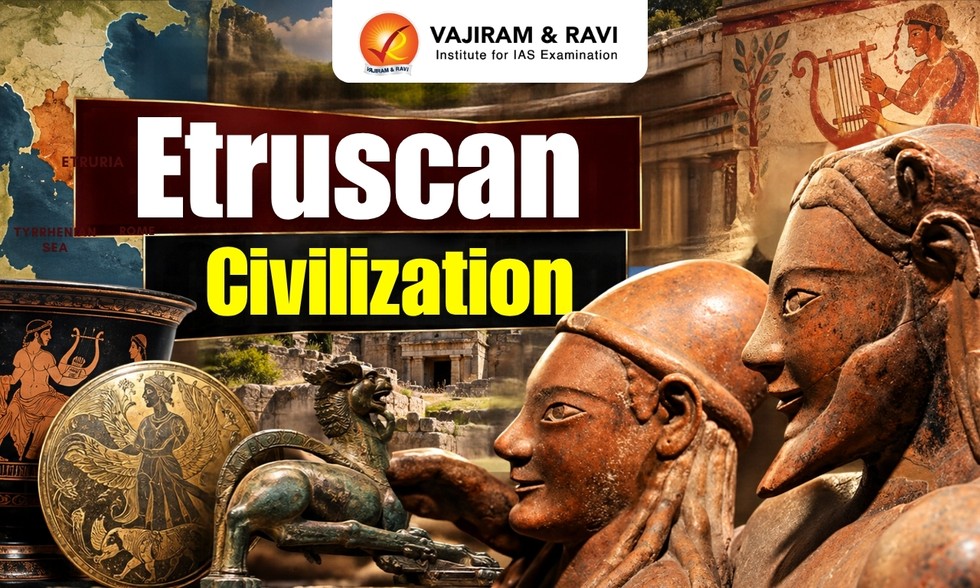
About Etruscan Civilization:
- It was a pre-Roman Mediterranean civilization that flourished between the 8th and 3rd centuries BCE.
- The Etruscans, also known as the Tyrrhenians, inhabited the area that is now Italy.
- Their country was called Tuscia, or Etruria, which was located in the central part of the Italian peninsula.
- They played a significant role in the cultural and political development of early Rome.
- They established a confederation of twelve city-states.
- One of the key features of Etruscan society was their system of government.
- The Etruscans were ruled by a series of kings, who were elected by the members of the aristocratic families.
- This system of government was highly decentralised, with each city-state having its own king and its own system of laws and governance.
- Etruscan society was marked by a high degree of leisure and luxury, evident in their art, elaborate burial practices, and the status of women, who experienced more equality compared to many contemporary cultures.
- The Etruscans were skilled traders and builders, known for their wealth derived from local metal deposits and fertile agricultural land.
- The Etruscans possessed the biggest iron reserves in the whole of the western Mediterranean.
- They had a strong navy and dominated the seas on the western coast of Italy.
- They developed advanced architectural techniques, including the use of the arch and vault.
- Etruscans were the first in the Mediterranean region to construct a city on the basis of a grid plan.
- In this plan, most of the streets were laid in a north-south direction with a few streets crossing them from the east-west direction.
- Despite their many accomplishments, the Etruscan civilization began to decline in the 5th c. BC, as they were gradually absorbed into the expanding Roman Republic.
- The Romans were heavily influenced by Etruscan culture and adopted many of their traditions and practices, such as their system of government, their religious beliefs, and urban planning.