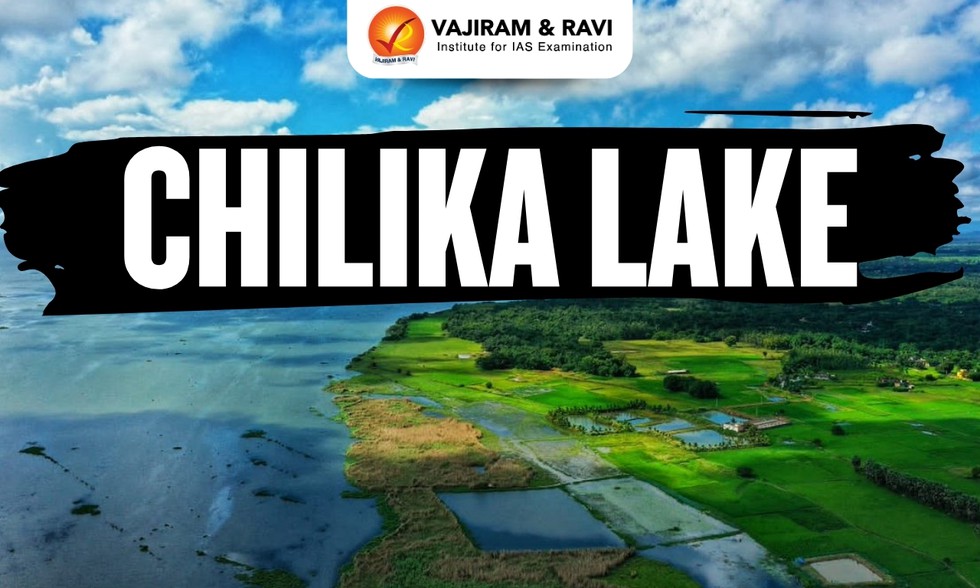
The Odisha government is preparing a new action plan for the protection of Chilika Lake’s biodiversity and the development of its surrounding areas.
About Chilika Lake:
It is a brackish water lake and a shallow lagoon with estuarine character spread across the districts of Puri, Khurda, and Ganjam in the state of Odisha.
It is Asia’s largest brackish water lake.
Located at the mouth of the Daya River, Chilika Lake is the second-largest brackish water lagoon in the world, after the New Caledonian barrier reef in New Caledonia.
The waterspread area of Chilika varies between 900 to 1165 sq. km. during summers and monsoons, respectively.
It is connected to the Bay of Bengal by a 32 km long and 1.5 km wide channel that mostly runs parallel to the Bay, separated by a narrow spit.
Chilika Lake has several islands, such as:
Nalabana Island – Declared a Bird Sanctuary (1987)
Kalijai Island – Known for the Kalijai Temple
Other islands include Honeymoon Island, Breakfast Island, Beacon Island, Satpada Island,
In 1981, Chilika Lake was designated the first Indian wetland of international importance under the Ramsar Convention.
Biodiversity:
It is the largest wintering ground for migratory birds on the Indian subcontinent.
Birds from the Caspian Sea, Lake Baikal, Aral Sea, and other remote parts of Russia, Kirghiz steppes of Mongolia, Central and Southeast Asia, Ladakh and Himalayas come here.
White-bellied sea eagles, Graylag Geese, Purple Moorhen, Jacana, Herons, and Flamingos are among the many species which make the lake a bird watcher's delight.
It is also home to one of the world's largest breeding colonies of Flamingos.
Apart from the avifaunal species, the region also highlights varied wild animals such as Blackbuck, Golden Jackals, Spotted Deer, and Hyenas.
It is also famous for its population of Irrawaddy dolphins.
Dear Student,
You have still not entered your mailing address. Please enter the address where all the study materials will be sent to you. (If applicable).