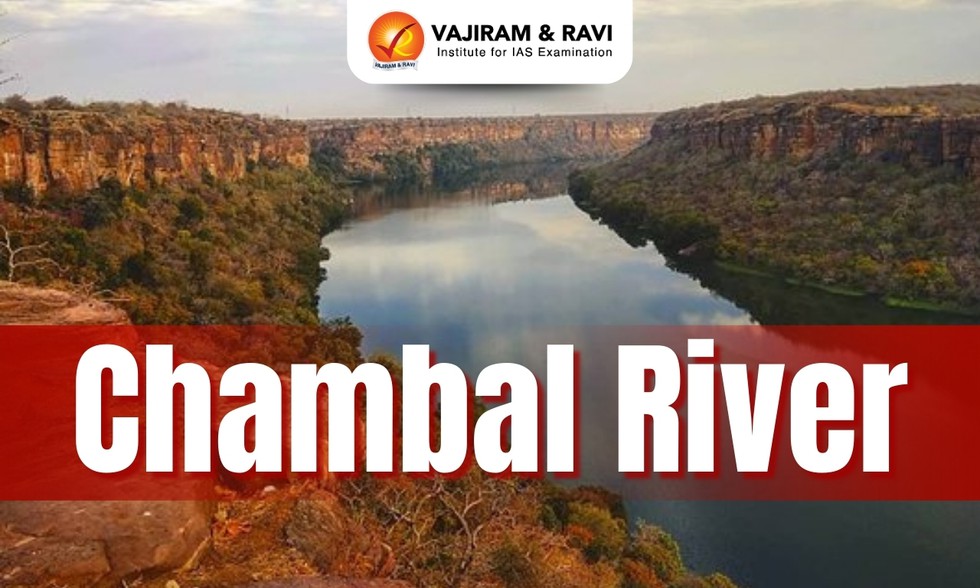
Efforts to reclaim degraded land from Chambal ravines expose both people and biodiversity to ecological risks from erosion and flooding.
About Chambal River:
The Chambal River, called Charmanvati in ancient times, is one of the major tributaries of the Yamuna
Located in Central India, the river forms part of the greater Gangetic drainage system.
Course:
It is a perennial river and has its source in Janapav, located to the south of Mhow Town close to Indore on the southern sides of the Vindhya Mountain Range in Madhya Pradesh.
It flows through three Indian states: Madhya Pradesh, Rajasthan, and Uttar Pradesh.
The Chambal and its tributaries drain the Malwa region of northwestern Madhya Pradesh, while its tributary, the Banas, which rises in the Aravalli Range, drains southeastern Rajasthan.
Notable Landmark:Pachnada confluence in Uttar Pradesh, where it meets the Kwari, Yamuna, Sind, and Pahuj rivers.
Major Dams: Gandhi Sagar, Jawahar Sagar, Rana Pratap Sagar, and Kota Barrage dams are built on this river.
National Chambal Sanctuary:
Established in 1979, it covers Rajasthan, Madhya Pradesh, and Uttar Pradesh.
Known for protecting the critically endangered Gharial crocodile, along with other crocodile species, turtles, and diverse fish.
A hotspot for bird watching with many bird species, including the endangered Indian Skimmer.
What is a Ravine?
It is a narrow valley with steep sides, usually caused by stream bank erosion.
Ravines are smaller than canyons and larger than gullies.
Dear Student,
You have still not entered your mailing address. Please enter the address where all the study materials will be sent to you. (If applicable).