Recently, India and Canada signed a Joint Statement on Energy Cooperation on the sidelines of India Energy Week (IEW) 2026 in Goa.
About Canada:
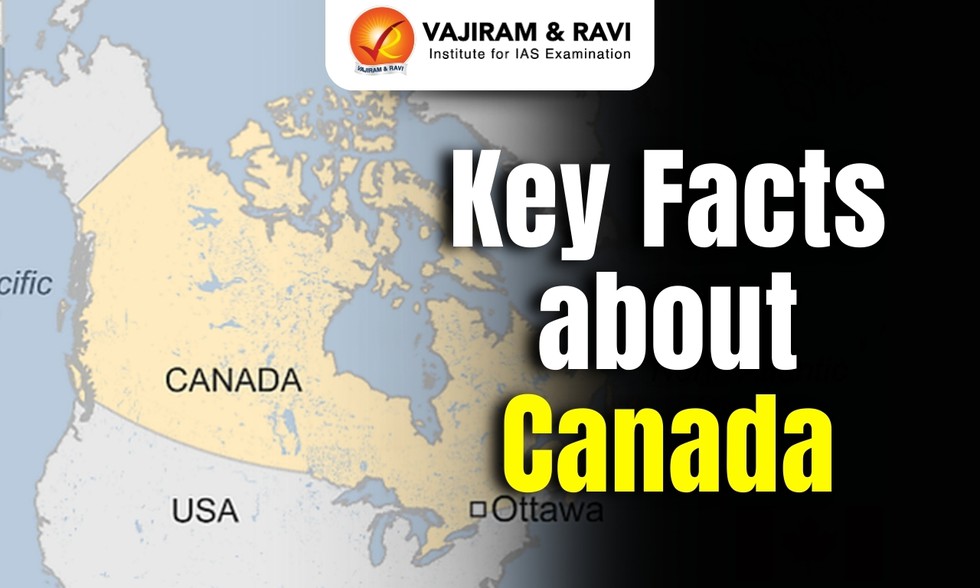
Location: It is located in the northern part of North America.
It is the second largest country in the world in area (after Russia).
Bordered by: It shares borders with Alaska, a non-contiguous US state, to the northwest, and other US states to the south.
The border of Canada with the US is the longest bi-national land border in the world.
Maritime Borders: It is bounded by the Arctic Ocean tothe north, by the Atlantic Ocean to the east and the Pacific Ocean to the west.
It also shares maritime borders with the island of Greenland in the northeast and the French island regions of Saint Pierre and Miquelon in the southeast.
Capital City: Ottawa
Geographical Features of Canada:
Climate: It has seven climatic regions namely, the Arctic, Subarctic, Prairie, Great Lakes, Cordilleran, plus the East and West Coasts.
Major Mountains: Rocky Mountain, the St. Elias Mountains and the Laurentian Mountains.
Major Rivers: Mackenzie River, Yukon River, Saint Lawrence River.
Lakes: The five Great Lakes namely Superior, Michigan, Huron, Ontario, and Erie form a natural boundary between Canada and the United States. (Amongst these five, only Lake Michigan lies entirely within the US).
Natural Resources: Bauxite, Iron ore, Nickel, Zinc, copper, gold, lead, uranium, rare earth elements, potash, diamonds etc.
Dear Student,
You have still not entered your mailing address. Please enter the address where all the study materials will be sent to you. (If applicable).