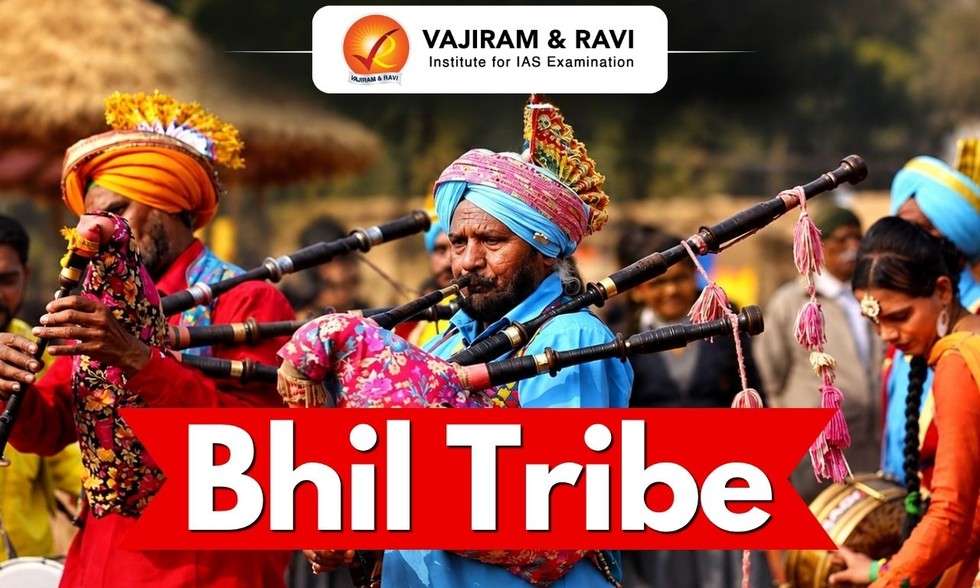
The Rajasthan High Court recently issued notices to the State government and other authorities on a petition seeking a 9% sub-quota for the Bhil community within the existing 12% reservation for the Scheduled Tribe (ST) category.
About Bhil Tribe:
The Bhils are considered one of the oldest tribes in India and are identified as one of the Dravidian racial tribes of Western India and belong to the Australoid group of tribes.
According to the 2011 census, Bhil is the largest tribal group in India, constituting approximately 38% of the total scheduled tribal population of India.
The name ‘Bhil’ is derived from the word “villu” or “billu”, which, according to the Dravidian language, is known as Bow.
Their reference is in old literature, Ramayana and Mahabharata.
Distribution:
They are the most widely distributed tribal groups in India.
They mainly reside in Rajasthan, western Madhya Pradesh, Gujarat and northern Maharashtra. Some families have migrated to other states like Tripura for jobs in tea gardens.
Bhil populations are concentrated in the southernmost hills of the Aravalli Range, the western uplands of the Vindhya and Satpura ranges, and the northernmost hills of the Western Ghats.
Some Bhil groups occupy the nearby river valleys and coastal plains.
Occupation: Nearly all of the Bhil engage in agriculture, some using the slash-and-burn (jhum) method but most employing the plow.
Language:
They speak Bhili, which is an Indo-Aryan language.
Bhili dialects show varying degrees of influence of regional languages such as Rajasthani and Marathi, but they all appear to have their origins in Gujarati.
Beliefs:
Almost all Bhils practice ethnic religions that have been highly influenced by Hinduism.
Most of them worship local deities like Khandoba, Kanhoba, Bahiroba, and Sitalmata. Some worship the Tiger God called ‘vaghdev’.
Festivals:
The Baneshwar fair is the main festival celebrated among the Bhils. This fair is held during the period of Shivaratri in the months of January or February.
The Hindu festivals of Holi and Dusshera are the other major festivals celebrated among the Bhil Tribes in India.
Art and Culture:
The Ghoomar dance, which is a traditional folk dance symbolising womanhood, is one of the popular aspects of Bhil culture.
Bhil painting is characterised by the use of multi-coloured dots as in-filling.
Dear Student,
You have still not entered your mailing address. Please enter the address where all the study materials will be sent to you. (If applicable).