
Key Facts about Baiga Tribe
Growing consumption of processed foods and changing modern diets are making residents of urban cities lose what Madhya Pradesh's Baiga tribe has still preserved: a rich diversity of ancestral gut microbes that nourish the body.
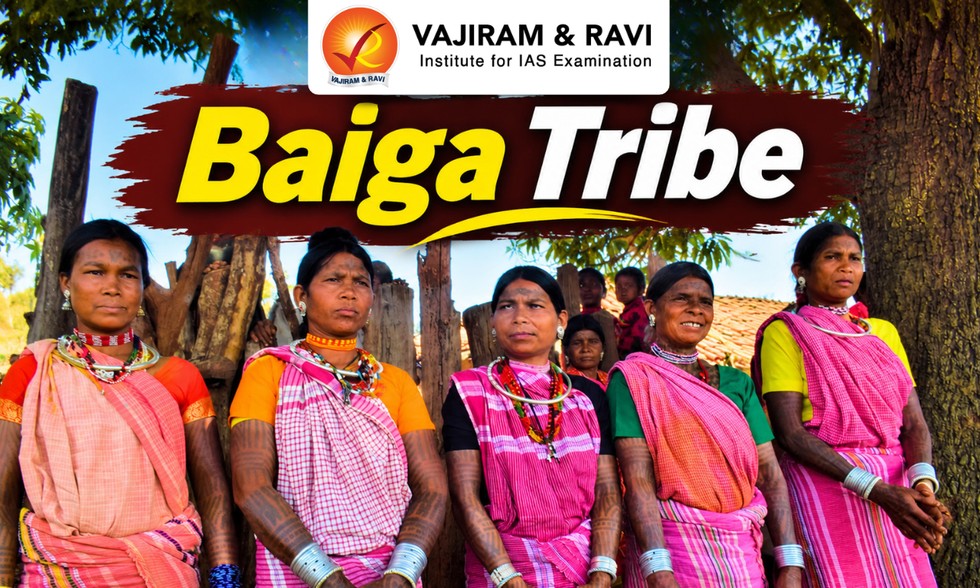
About Baiga Tribe:
- They are an indigenous tribal community found in Central India, primarily in the state of Madhya Pradesh, and in smaller numbers in the surrounding states of Uttar Pradesh, Chhattisgarh, and Jharkhand.
- They are recognised as a Particularly Vulnerable Tribal Group (PVTG) in India.
- The largest number of Baiga is found in Baiga-chuk in the Mandla district and Balaghat district of Madhya Pradesh.
- They mainly inhabit forested and hilly regions, particularly the Maikal hill ranges.
- They have sub-castes – Bijhwar, Narotia, Bharotiya, Nahar, Rai Bhaina, and Kadh Bhaina.
- The word ‘Baiga’ means ‘sorcerer-medicine man’ which might have come from their practices of healing illness through rituals, traditional herbs, prayers, and offerings to God.
- Language:
- It is believed that the ancestors of the Baigas spoke an Austro-Asiatic language; however, no trace of it is left now.
- Some Baigas (specifically those from the Mandla district) have mentioned "Baigani" as their mother tongue in the past: Baigani is now recognised as a variety of Chhattisgarhi influenced by Gondi.
- Most Baigas speak Hindi, and some of them also know a few local languages, such as Gondi and Marathi, depending on the region where they live.
- Traditionally, Baiga houses were built around a central shared courtyard where a bonfire blazed during the nights.
- A distinguishing feature of the Baiga tribe is that their women are famous for sporting tattoos of various kinds on almost all parts of their body.
- Tattoos are made using kajal derived from Ramtilla seeds (Niger seeds).
- Of the several dance forms of the Baigas, Karma is the most popular one.
- Livelihood:
- Traditionally semi-nomadic, they practised slash-and-burn cultivation, locally called “Bewar”, and now depend mainly on minor forest produce.
- Ploughing the earth was prohibited in their tradition—being equated with ploughing the breast of one’s own mother.
- Mahua is an important aspect of Baiga's food and drink. It is an intoxicant prepared from the fermentation and distillation of the flowers of the Mahua tree ( Madhuca longifolia)
- Beliefs:
- Most Baiga are Hindu, but they have combined Hindu practices with their own beliefs.
- Baigas follow folk beliefs and mix them with taboos.
- The Baiga tribe is the first community in India to be granted habitat rights under the Forest Rights Act of 2006, reflecting their deep connection with forests.