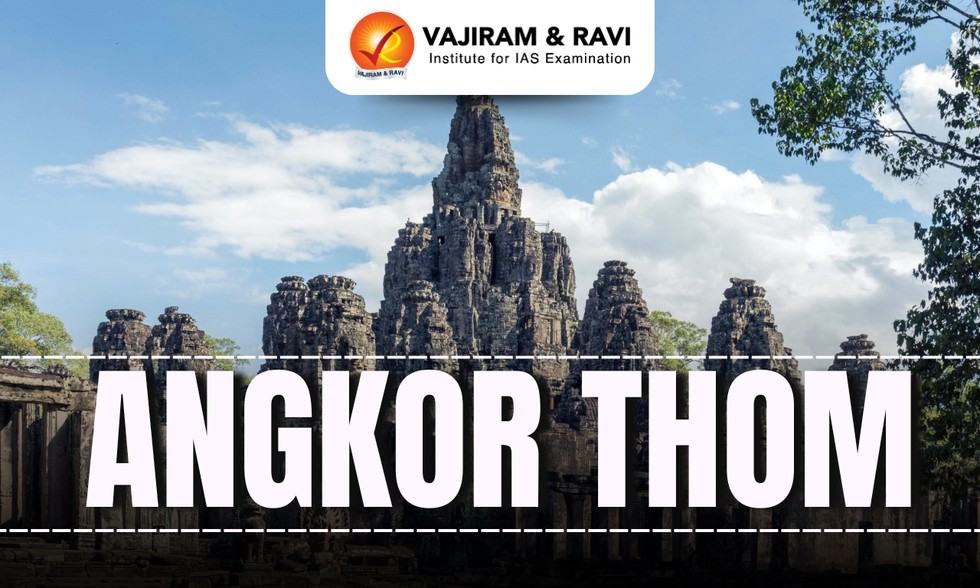
Archaeologists recently uncovered significant remains of a 12th-century hydraulic system and architectural features within the ancient royal palace complex of Angkor Thom.
About Angkor Thom:
Angkor Thom, located in present-day Cambodia, was the last and longest-lasting capital of the ancient Khmer Empire.
Angkor Thom translates into English as the “Great City”.
The complex is located in the north of Angkor Wat, between West Baray and East Baray.
History:
It was established after Jayavarman VII reclaimed the Khmer capital from the Cham invaders in 1181.
Unlike earlier Hindu temples, Angkor Thom was designed as a Buddhist city, reflecting the king’s devotion to Mahayana Buddhism.
However, it also incorporated elements of Hinduism and ancestral worship, showcasing the empire’s religious syncretism.
Angkor Thom witnessed the reign of the greatest Angkor king until 1219 and remained the capital of the Khmer Empire throughout its decline, which probably led to the complete abandonment in the 16th century.
Features:
It covers an area within which are located several monuments from earlier eras as well as those established by Jayavarman and his successors.
It is a square-shaped city with higher walls and about 3 kilometres long on each side.
A moat surrounds the outside of the city.
Bayon Temple: At its centre stands the famous Bayon, renowned for its numerous giant stone faces.
Other Important Structures:
Terrace of the Elephants
Terrace of the Leper King
Baphuon
Phimeanakas
Angkor Thom is part of the Angkor Archaeological Park, a UNESCO World Heritage Site inscribed in 1992.
Dear Student,
You have still not entered your mailing address. Please enter the address where all the study materials will be sent to you. (If applicable).