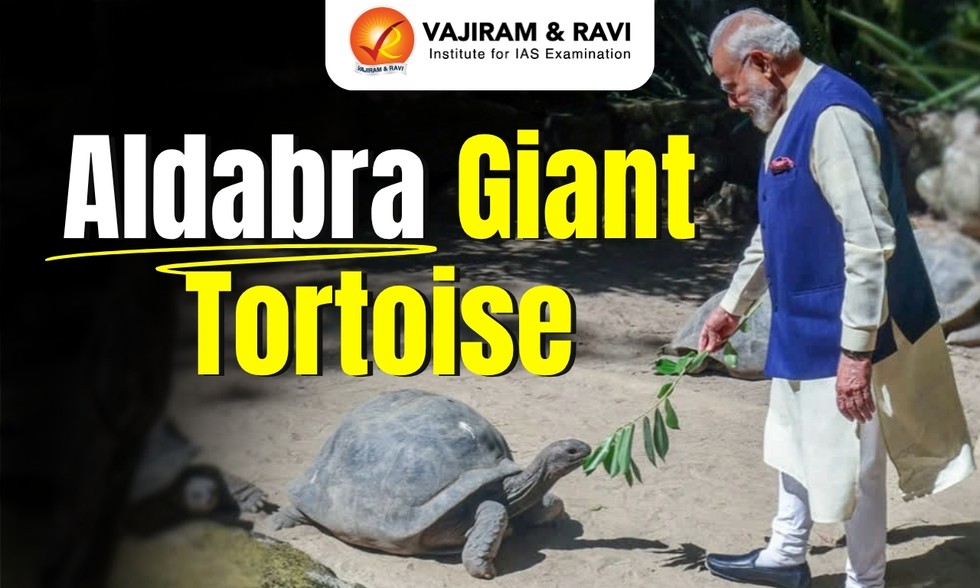
About Aldabra Giant Tortoise:
- It is the second-largest species of land tortoise in the world, after the Galapagos giant tortoise (Chelonoidis nigra).
- Scientific Name: Geochelone gigantea
- Habitat and Distribution:
- It is endemic to the Aldabra Atoll of the Seychelles, an archipelago nation in the western Indian Ocean.
- It is terrestrial and occurs in a wide variety of habitats, including scrub forests, mangrove swamps, and coastal dunes and beaches, each with their respective vegetation.
- The largest populations of tortoises are found on grasslands called “platins.”
- Their heavy grazing has formed a special kind of grassland habitat called “tortoise turf.”
- Features:
- Males are considerably larger than females and have longer, thicker tails.
- Their carapace (or upper shell) is highly domed and thick, with a small neck plate that is usually visible, a feature absent in other species of giant tortoises.
- Lifespan: It is among the longest-living vertebrates, with many individuals living over 100 years and some believed to exceed 150 years.
- Conservation Status:
- IUCN Red List: Vulnerable.