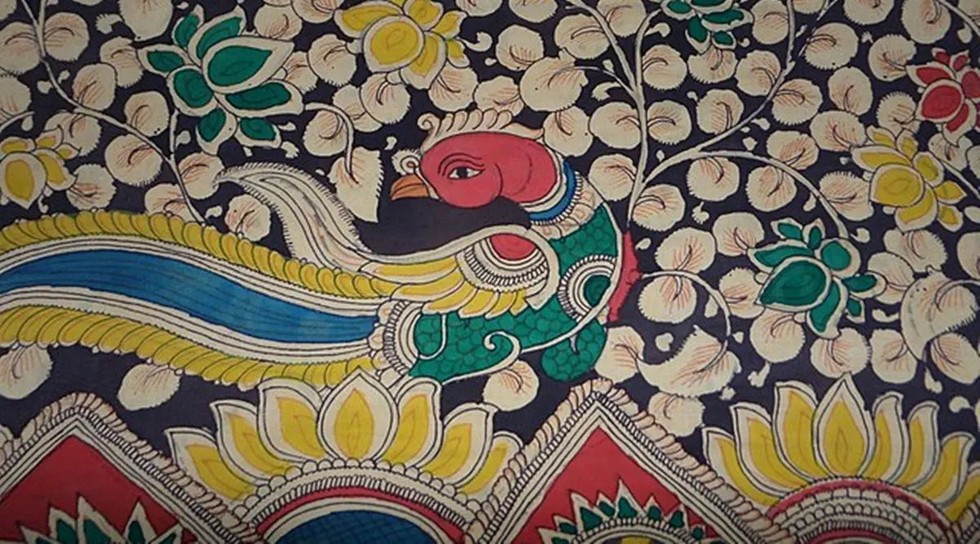
About Kalamkari Painting:
- It is a highly popular form of hand-painted or block-printed cotton textile and paintings, practised in Andhra Pradesh.
- It came up as a textile tradition during the reign of Qutb Shahis at Golconda in the 16-17th century.
- “The word ‘Kalam’ meant pen, while ‘Kari’ meant craftsmanship.
- Kalamkari Painting Techniques:
- The process of creating Kalamkari begins by soaking the fabric in a mixture of astringents and buffalo milk, followed by drying it in the sun.
- The outlines of the design in red, black, brown, and violet are drawn using a mordant, after which the cloth is dipped in an alizarin bath.
- Wax is then applied to the areas that remain undyed, and the fabric is immersed in indigo dye.
- Once the wax is removed, the remaining areas are hand-painted.
- Artists use a bamboo or date palm stick with fine hair attached to create design contours, applying natural dyes extracted from roots, leaves, seeds, and minerals like iron and copper.
- Kalamkari Painting Styles: It is broadly divided into two distinct styles based on the regions where the art form developed—Srikalahasti and Machilipatnam.
- Srikalahasti Kalamkari:
- It is practised in Srikalahasti of Tirupati district and is done entirely by hand using the kalam (pen).
- This form is characterized by freehand drawing and intricate detailing.
- Theme: It portrays mythological figures and themes, religious iconography, temple architecture, and Hindu deities.
- Machilipatnam Kalamkari:
- It is also known as Pedana Kalamkari, developed in Pedana near Machilipatnam.
- It is deeply influenced by Persian art due to the patronage of the Mughals and the Golconda Sultanate.
- Theme: It uses block-printing techniques, focusing on floral and geometric designs.