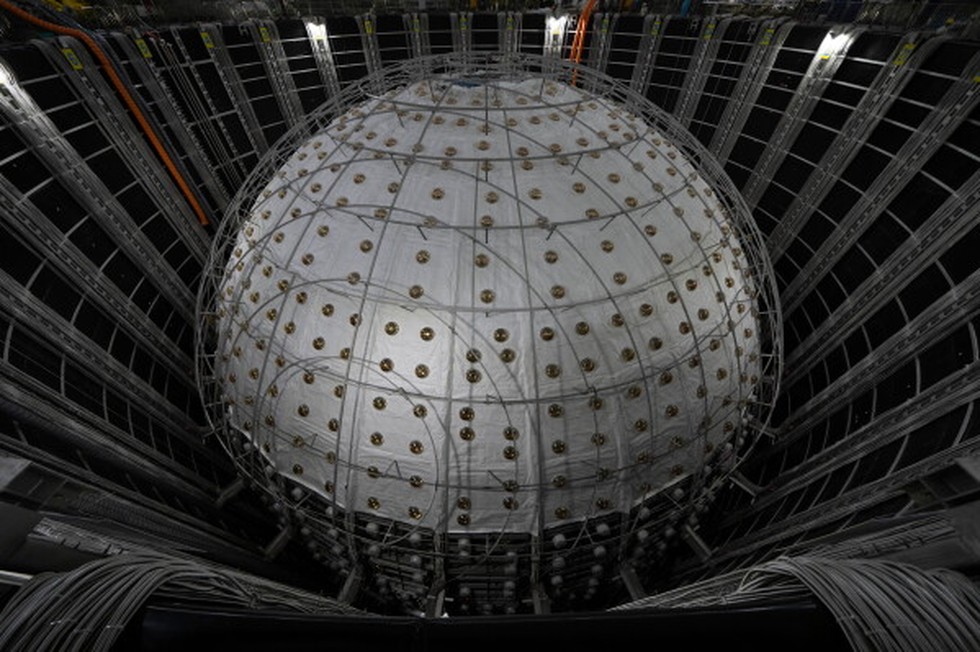
About Jiangmen Underground Neutrino Observatory (JUNO):
- It is a large underground neutrino detector located near the city of Kaiping in the southern Guangdong province of China.
- It is the product of an international collaboration involving 74 institutions from Asia, Europe, and America.
- It is led by the Chinese Academy of Sciences (CAS) via the Institute of High Energy Physics (IHEP).
- It is the second neutrino experiment in China, after the Daya Bay Reactor Neutrino Experiment.
- The primary JUNO scientific goal is the determination of the neutrino mass ordering (NMO).
- This can be inferred by measuring the oscillation pattern of electron anti-neutrinos emitted by nuclear power plants.
- To do this, the facility has an 80 m high and 50 m diameter experimental hall located 700 m underground.
- Its main feature is a 35 m radius spherical neutrino detector, containing 20,000 tonnes of liquid scintillator.
- It is the world's largest and highest-precision liquid scintillator detector.
- Juno is designed to have a scientific lifespan of up to 30 years.
- JUNO is also one of three next-generation neutrino experiments, the other two being the Hyper-Kamiokande in Japan and the Deep Underground Neutrino Experiment in the US.
What are Neutrinos?
- Neutrinos, often called 'ghost particles', are elementary particles that belong to the lepton family of particles.
- Since neutrinos have very little interaction with matter, their detection is very difficult.
- They have no electrical charge and have a very small mass (less than one millionth of the mass of the electron), and their speed is nearly equal to the speed of light.
- First predicted in 1930, they weren’t discovered in experiments until 1956.
- Of the four fundamental forces in the universe, neutrinos only interact with two — gravity and the weak force.
- Source: Neutrinos come from all kinds of different sources and are often the product of heavy particles turning into lighter ones, a process called “decay.”
- They are the most common particles in the universe.
- Approximately 100 trillion neutrinos pass completely harmlessly through your body every second.
- Neutrinos play crucial roles in the standard model of particle physics, in stellar physics and black holes, and even in cosmology and the nature of the Big Bang.