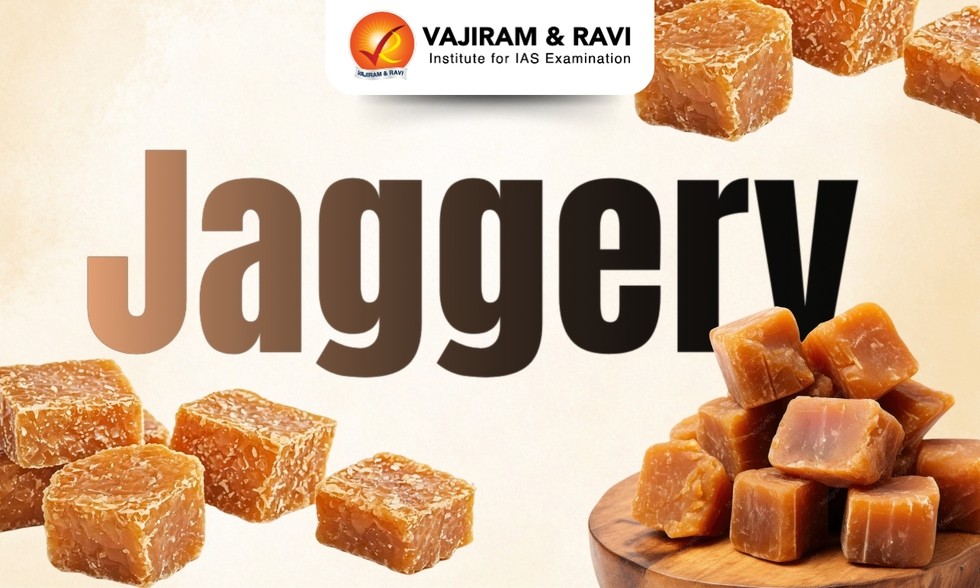
India accounts for over 70% of global jaggery production, firmly establishing itself as the world leader in natural sweeteners.
About Jaggery:
It is commonly known as gur and is a traditional, unrefined, natural sweetener.
It is produced by concentrating sugarcane juice without the use of chemicals.
It retains essential minerals and micronutrients that are typically lost during the sugar-refining process.
Minerals: It retains minerals like calcium, magnesium, potassium, phosphorus, sodium, iron, zinc, copper, and manganese.
It also contains trace amounts of vitamins, including folic acid and B-complex vitamins, as well as vitamins A, C, D, and E.
Production:
India accounts for over 70 percent of global jaggery production. This makes it the world’s largest jaggery producer.
Uttar Pradesh contributed 48.5 percent of total production, followed by Maharashtra (24.1 percent) and Karnataka (10.5 percent).
Geographical Indication (GI) Tagged Jaggery Varieties in India:
Kolhapur Jaggery (Maharashtra): It is valued for its golden colour and high sucrose content.
Muzaffarnagar gur (Uttar Pradesh): It is export-oriented and made from high-quality cane.
Marayoor and Central Travancore jiggery (Keralam): These are recognized for their purity, medicinal value, traditional processing and regional distinctiveness.
Dear Student,
You have still not entered your mailing address. Please enter the address where all the study materials will be sent to you. (If applicable).