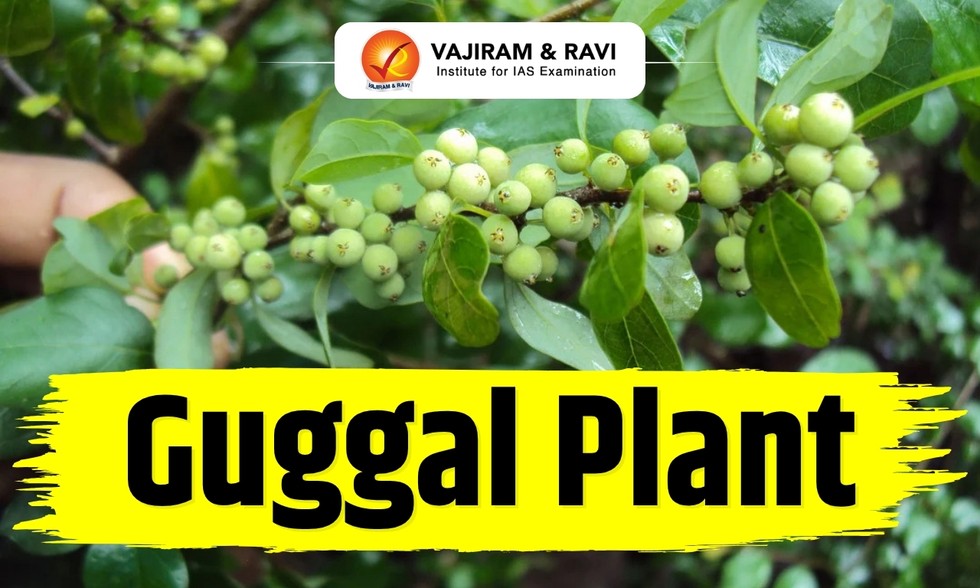
A Kutch-based non-profit is planting Khara and Mitha Guggal across five villages to restore native medicinal heritage and biodiversity on community grazing lands.
About Guggal Plant:
It is a spiny shrub or small tree belongs to Burseraceae family.
Distribution: It is native to India, Arabia and Pakistan.
In India, it is found in the arid, rocky tracts of Rajasthan, Gujarat, Madhya Pradesh and Karnataka in India.
Characteristics:
The plant prefers arid and semi-arid climates and is tolerant of poor soil.
It grows well in sandy to silt loam soils, which are poor in organic matter and rich in other matters and also considered as drought and salinity resistant plant.
Uses:
Traditional Uses: Gum guggul is used as incense, to make lacquers, varnishes, and ointments, as a fixative in perfumes, and in medicine.
Modern Uses: Modern therapeutic uses of guggul include nervous diseases, hemiplegia, leprosy, marasmus, musclespasms, neuralgia rtc.
Guggal-gum extract targets the Farnesoid X Receptor (FXR) that regulates cholestrol and checks bile acids produced from cholestrol by the liver.
The resin from the Guggal tree, known as guggul, is valued in Ayurvedic medicine for treating various ailments.
Dear Student,
You have still not entered your mailing address. Please enter the address where all the study materials will be sent to you. (If applicable).