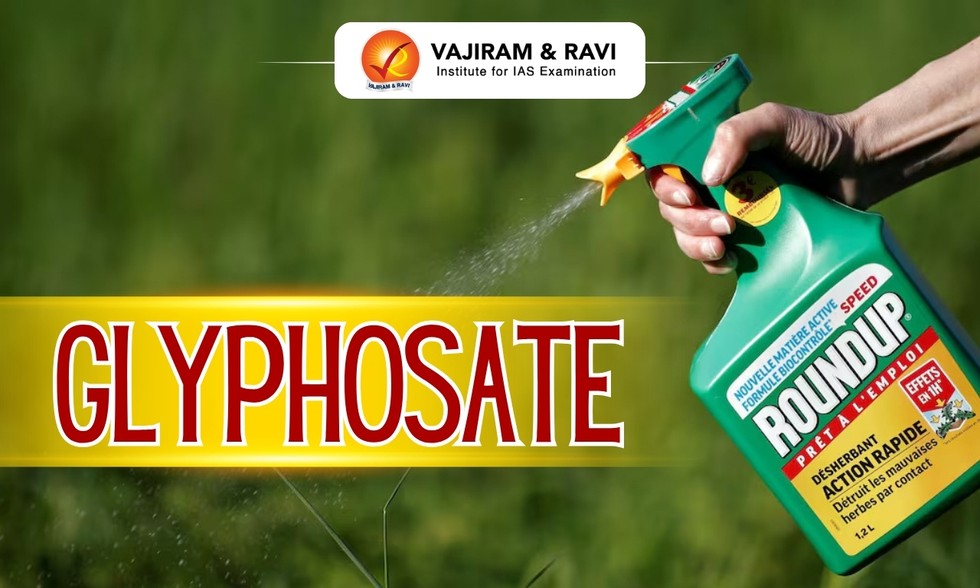
Recently, environmentalists have raised concern over the alleged use of glyphosate on forest department land for pea cultivation in parts of Himachal Pradesh.
About Glyphosate:
It is a widely used herbicide that can kill certain weeds and grasses.
It is considered a broad-spectrum herbicide, meaning it can effectively control a wide variety of plants, including grasses, broadleaf plants, and woody plants.
Impact of Glyphosate:
Herbicidal Action: It works by inhibiting an enzyme called EPSP synthase, which is essential for the synthesis of certain amino acids that plants need for growth.
It disrupts this enzyme; glyphosate interferes with the plant’s ability to produce proteins, leading to the eventual death of the plant.
Broad-Spectrum: It is effective only on plants that grow above the water.
It will not be effective on plants that are submerged or have most of their foliage underwater, nor will it control regrowth from seed.
It is degraded in soil and water by microbes and binds tightly to soil particles, which prevents the leaching of glyphosate into groundwater.
It does not degrade quickly in plants. As a result, it is possible that glyphosate residues can occur in food products.
Dear Student,
You have still not entered your mailing address. Please enter the address where all the study materials will be sent to you. (If applicable).