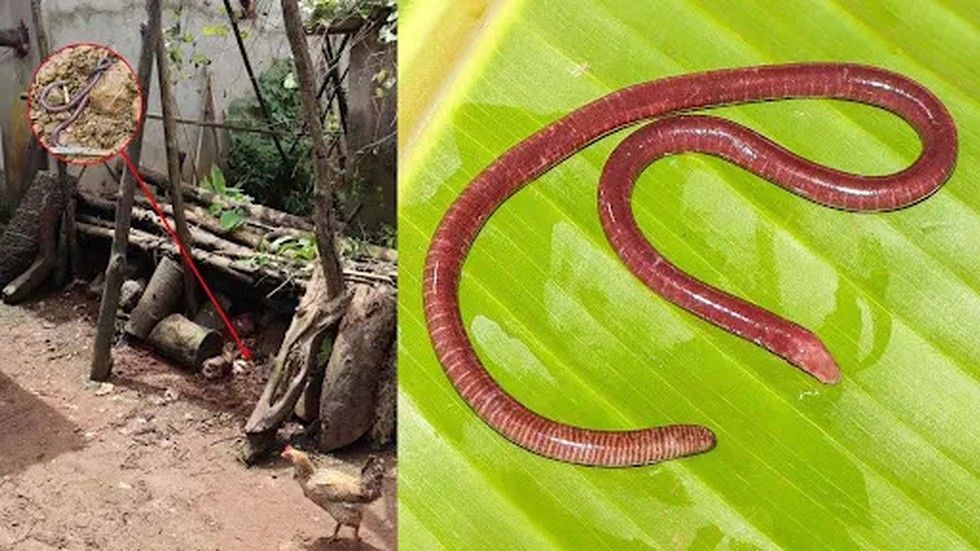
About Gegeneophis chandgadi:
- It is caecilians species discovered in the state of Maharashtra.
- Caecilians may look like oversized earthworms or small snakes and this group of amphibians live mostly underground.
- The species name, chandgadi, is a tribute to the local culture.
- It is named after the ‘Chandgadi language,’ a distinct dialect of Marathi spoken by the people living in the region where the animal was found.
- Distribution: The researchers noted that the northern Western Ghats is a hotspot for these elusive animals.
- Features
- It has a slender, flesh-colored body and a specific pattern of rings (called annuli) that encircle its trunk.
- It has primary rings along its entire length; its secondary rings are concentrated only on the back half of its body.
- It is a legless, worm-like amphibian.
What are Caecilians?
- These are tropical amphibians that look like large worms or slick snakes.
- They have no arms or legs, and their shiny skin is ringed with skin folds called annuli.
- Most caecilians are burrowers, living in a network of tunnels underground. A hard, thick, pointy skull helps these amphibians dig in soft dirt.
- Habitat:
- Most caecilians inhabit moist tropical and subtropical regions of South and Central America, South and Southeast Asia, and Sub-Saharan Africa.
- Almost all caecilians are terrestrial, but they are elusive as they spend the majority of their lives underground.