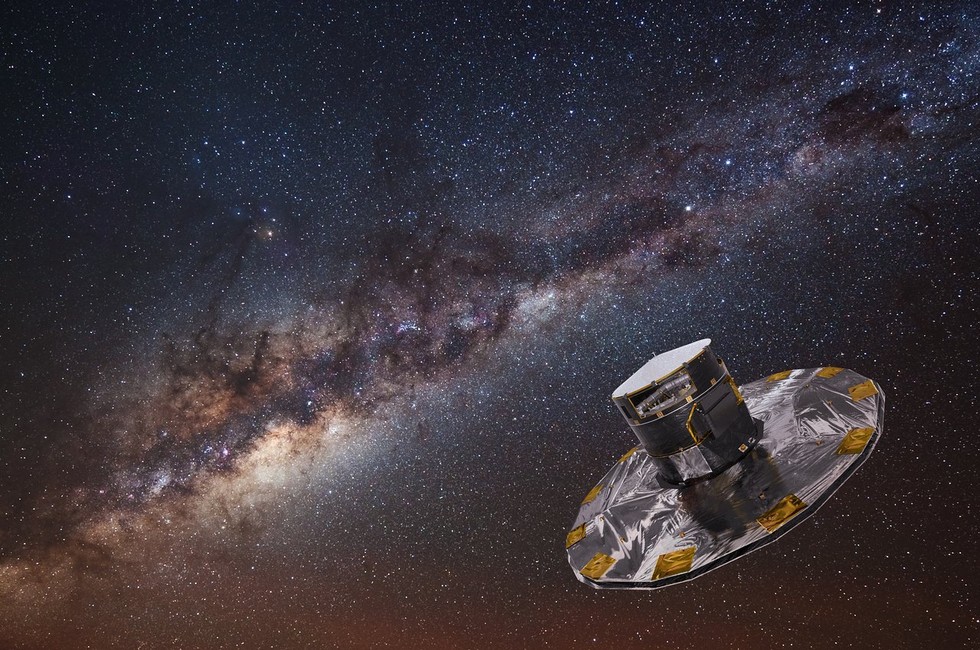
Recently, a team led by Indian astronomers redefine star cluster UBC 63 as a double cluster system spotted after close flyby using data from the European Space Agency's (ESA) Gaia mission.
About GAIA Mission:
It was originally named Global Astrometric Interferometer for Astrophysics (GAIA), later simplified to Gaia.
It was launched in 2013 by the European Space Agency (ESA).
It aimed to create the most precise 3D map of the Milky Way through astrometry.
It is placed at Lagrange Point 2 (L2), 1.5 million km from Earth (behind Earth when viewed from the Sun).
Scientific Instruments:
Twin Telescopes: Captured light from different directions.
Digital Camera: Nearly 1 billion pixels, the largest ever flown in space.
Three Key Instruments:
Astrometer: Measures precise locations of celestial bodies.
Photometer: Determines brightness and temperature of stars.
Spectrometer: Identifies chemical composition and motion of objects.
What is UBC 63?
It is poorly populated group of stars, bound loosely by gravity (Galactic open cluster) about 4892 light years away from the Earth.
It was previously identified as a single star cluster, has now been found to be composed of two distinct star clusters.
Dear Student,
You have still not entered your mailing address. Please enter the address where all the study materials will be sent to you. (If applicable).