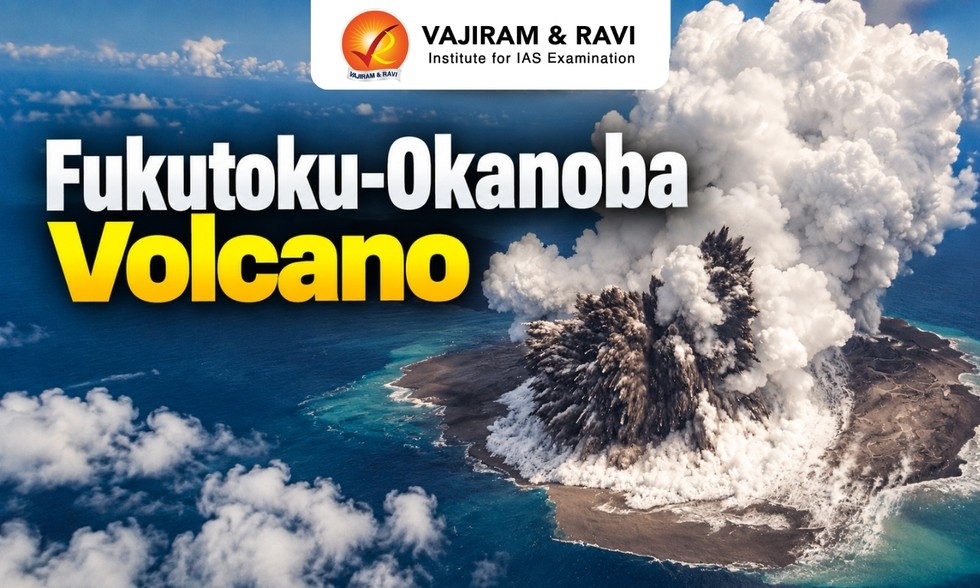
About Fukutoku-Okanoba Volcano:
- It is an active submarine volcano that is part of the Volcano Islands of Japan in the Pacific Ocean.
- It is part of the Izu-Bonin arc formed by subduction of the Pacific Plate beneath the Philippine Sea Plate.
- Its summit is just 14 meters (46 feet) below sea level, allowing Surtseyan eruptions to breach the surface.
- Composition is tholeiitic basalt, typical of arc front volcanism.
- It remains active with intermittent submarine eruptions and discoloured water since 2013.
- Eruptions are explosive with pumice rafts, discoloured water, and occasional ephemeral island formation.
- The 2021 eruption produced massive pumice rafts that drifted thousands of kilometres across the Pacific, impacting shipping and beaches.
- The volcano's frequent activity and shallow depth make it one of the most dynamic submarines, with eruptions often detected by satellite discoloration.
What is a Surtseyan Eruption?
- It is a type of volcanic eruption that takes place in shallow seas or lakes.
- It is named after the island of Surtsey off the southern coast of Iceland.
- When magma rises close to the surface of the water, it can come into contact with the water and cause it to flash to steam.
- The sudden increase in volume of the steam can cause an explosion, which can fragment the magma into small pieces.
- These pieces of magma, called tephra, can be ejected into the air, forming an ash column.
- These eruptions are commonly phreatomagmatic eruptions, representing violent explosions caused by rising basaltic or andesitic magma coming into contact with abundant, shallow groundwater or surface water.
- Tuff rings, pyroclastic cones of primarily ash, are built by explosive disruption of rapidly cooled magma.
- Surtseyan eruptions are relatively common, and they can be found all over the world.
- Surtseyan eruptions can be very dangerous.
- The ash and rock fragments that are ejected into the air can travel long distances, and they can be a hazard to ships and aircraft.
- The sudden expansion of steam can also cause shock waves, which can damage buildings and other structures.