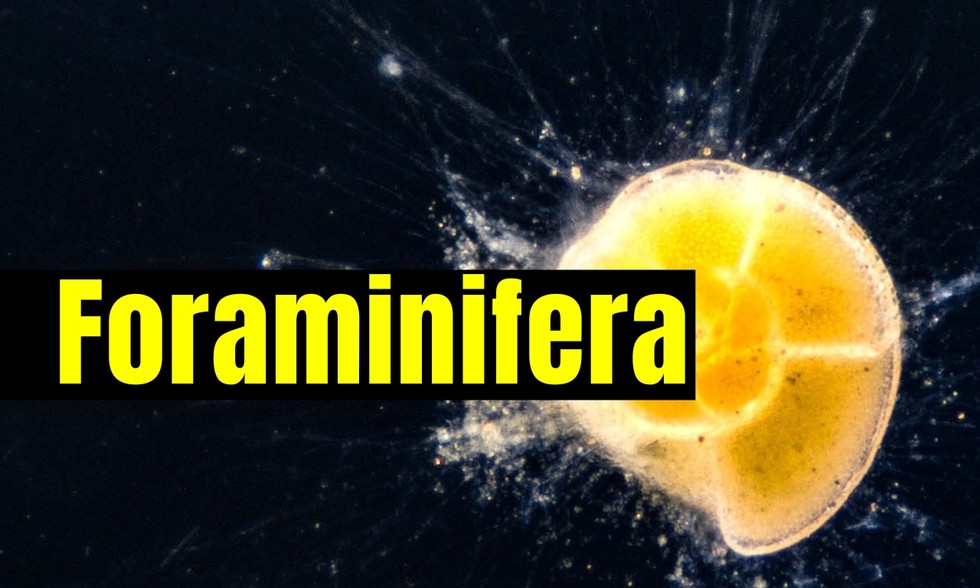
Recently, scientists at Agharkar Research Institute (ARI), Pune have discovered a new species of Foraminifera and named it as Portatrochammina bharatensis
About Foraminifera:
It is a group of single-celled organisms that have inhabited the world’s oceans for over 500 million years.
The shells have hundreds of tiny holes called foramen, the Latin word for window.
They are among the most abundant and ecologically important organisms in the ocean.
Features of Foraminifera:
Size: They are generally sand-grain size, measuring between 500 and 50 µm.
Habitat: They live in the open ocean, along the coasts, and in estuaries.
Most have shells for protection and either float in the water column (planktonic) or live on the sea floor (benthic).
They construct their intricate shells, called “tests,” from materials they scavenge from their surroundings (agglutinating mineral grains).
The most of foraminifera” ‘crawl around’ using their pseudopodia.
They don’t have a wall around their cell membranes, they are extremely flexible and can change shape.
The organism pushes extensions of its cytoplasm called pseudopodia (or false feet) through these holes to gather food.
Diet: Foraminifera eat detritus on the sea floor and anything smaller than them: diatoms, bacteria, algae, and even small animals such as tiny copepods.
They build complex shells, consisting at their simplest of one chamber (like a vase or tube) to many chambers that coil in elaborate ways.
Dear Student,
You have still not entered your mailing address. Please enter the address where all the study materials will be sent to you. (If applicable).