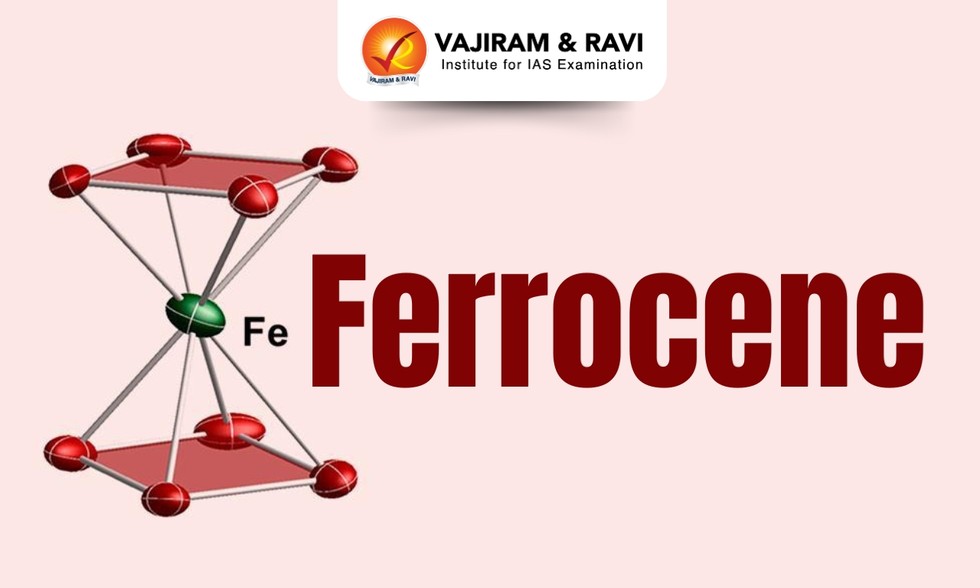
Researchers have achieved a major chemistry breakthrough by synthesizing a new carbon-free molecule that copies the unusual ‘sandwich’ structure of the famous carbon-containing ferrocene molecule.
About Ferrocene:
It is an orange crystalline organometallic compound with the formula Fe(C5H5)2.
It was first prepared in 1951 by the reaction of sodium cyclopentadienide with iron(+2) chloride.
Its discovery launched the field of organometallic chemistry, with numerous applications in materials science and medicine.
Properties:
It occurs as highly stable orange crystals with a melting point of 174° C (345° F).
Chemically, ferrocene behaves like benzene and other aromatic compounds in that it undergoes substitution reactions.
It has good solubility in a range of organic solvents but is insoluble in water.
Unique structure: It consists of an iron atom sandwiched between two flat carbon ringed-molecules.
Applications:
It is a widely used compound in a variety of modern technologies.
It is used in medicines, batteries, advanced materials and electronics.
Dear Student,
You have still not entered your mailing address. Please enter the address where all the study materials will be sent to you. (If applicable).