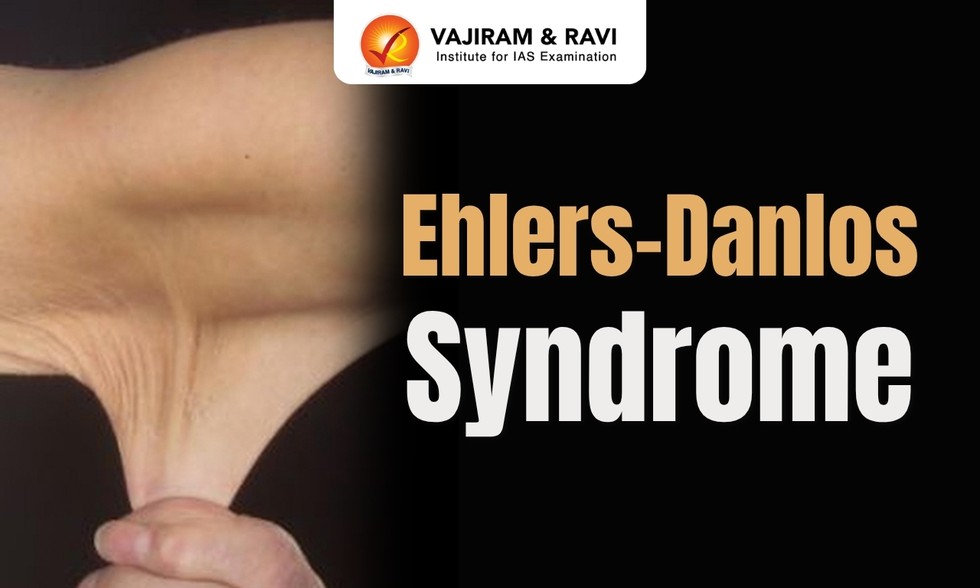
About Ehlers-Danlos Syndrome:
- It is a group of conditions that affect the connective tissue of the human body, typically loosening or weakening it.
- Connective tissue supports and provides flexibility to the skin, tendons, ligaments, bones, blood vessels, and organs.
- EDS is generally inherited and is commonly associated with hypermobility, meaning one’s joints can move past their normal range of motion.
- Cause: EDS is caused by certain genetic changes and is generally passed down to children by their parents.
- Types of Ehlers-Danlos Syndrome:
- Hypermobile EDS (hEDS):
- It is the most common form of EDS.
- It shows symptoms such as stretchy, fragile skin, loose and clicky joints that dislocate easily, joint pain, and joint hypermobility.
- hEDS may also manifest as extreme fatigue, skin that bruises quickly, digestive issues, and poor bladder control etc.
- Classical EDS:
- It is less common type of EDS, also exhibits similar symptoms, but it mostly affects the skin.
- A person with this condition might have very stretchy and fragile skin that bruises easily or splits easily, especially around the elbows, on the forehead, and on the knees.
- Vascular EDS:
- It affects one’s internal organs.
- This results in fragile blood vessels that can tear easily and cause internal bleeding, which can be life-threatening.
- This condition poses a serious risk of bowel tearing, womb tearing during pregnancy, and lung collapse etc.
- Kyphoscoliotic EDS (kEDS):
- It affects the curvature of the spine. It might manifest during early childhood and is also characterised by joint hypermobility and loose joints.
- Treatment: There is no cure for EDS, but symptoms, especially those of hEDS, can be managed.