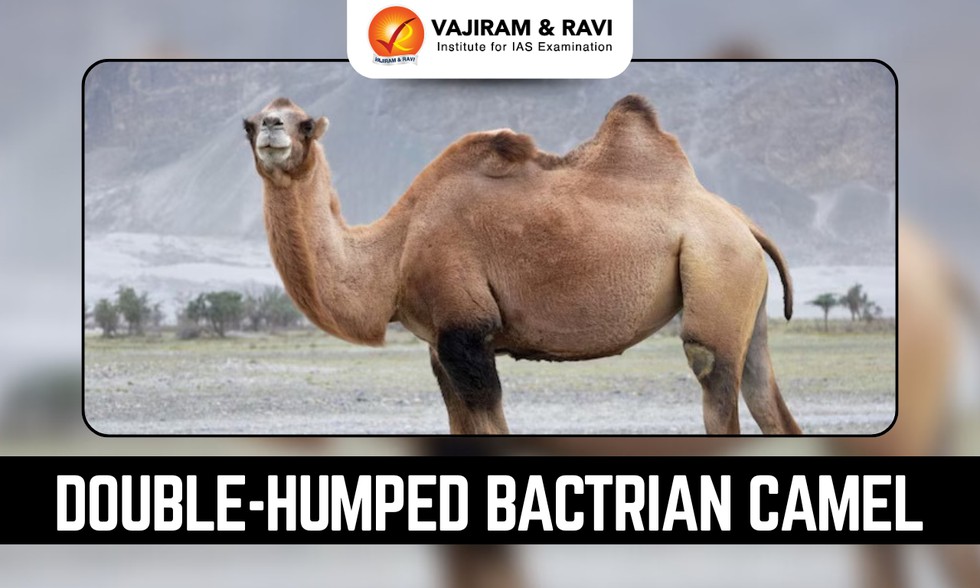
About Double-Humped Bactrian camel:
- It is scientifically known as Camelus bactrianus.
- It is large even-toed ungulates are renowned as Ladakh’s “silent warriors”.
- Distribution:
- They are native to the harsh and arid regions of Central Asia.
- They occupy habitats in Central Asia from Afghanistan to China, primarily up into the Mongolian steppes and the Gobi desert.
- Small populations of these camels are found in high altitude cold deserts of Ladakh’s Nubra Valley.
- Characteristics of Double-Humped Bactrian camel:
- The two humps, serves as a reservoir of fat that can be converted into water and energy during long treks where food is scarce.
- They possess thick, shaggy coats that fluctuate with the seasons, growing dense to withstand temperatures as low as minus 40 degrees Celsius.
- Their nostrils are sealable to block out frozen dust, while their broad feet act like natural snowshoes.
- They are among the few land animals that can survive by eating snowto meet their hydration needs.
- Diet: Bactrian camels are omnivores but primarily herbivores and eat various types of plants.
- Conservation Status:
- IUCN Red List: Critically Endangered.