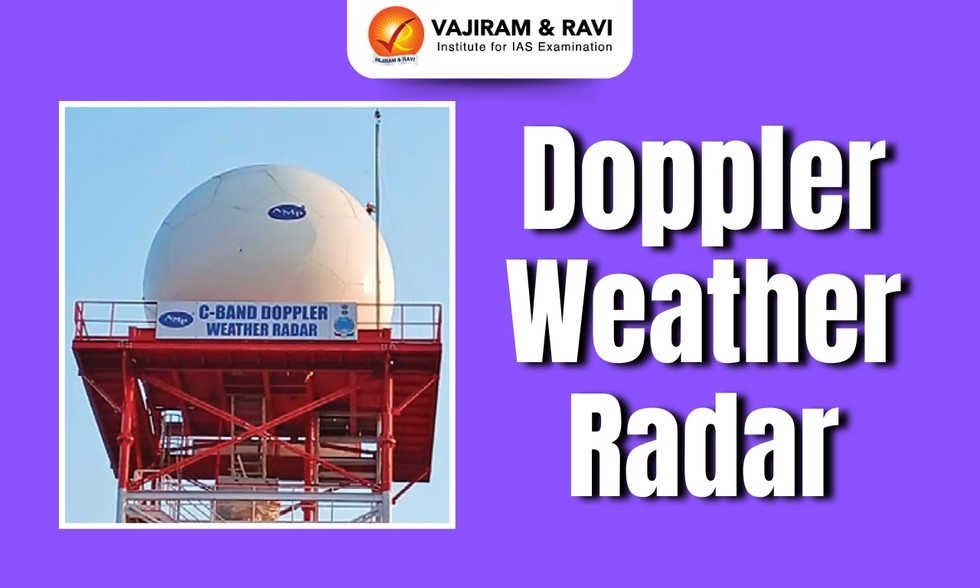
About Doppler Weather Radar:
- A Doppler radar is a specialized radar that uses the Doppler effect to produce velocity data about objects at a distance.
- These radar systems can provide information regarding the movement of targets as well as their position.
- Working of Doppler Weather Radars (DWRs)
- In radars, a beam of energy, called radio waves, is emitted from an antenna.
- When this beam strikes an object in the atmosphere, the energy scatters in all directions, with some reflecting directly back to the radar.
- The larger the object deflecting the beam, the greater is the amount of energy that the radar receives in return.
- Observing the time required for the beam to be transmitted and returned to the radar allows weather forecasting departments to “see” raindrops in the atmosphere, and measure their distance from the radar.
- Types of weather Radar Bands: Varying frequencies like S-band, C-band and X-band — are commonly used by the IMD in India.
- Applications:
- It is used to track the movement of weather systems and cloud bands, and gauge rainfall over its coverage area of about 500 km.
- An X-band radar is used to detect thunderstorms and lightning, whereas a C-band radar helps in cyclone tracking.