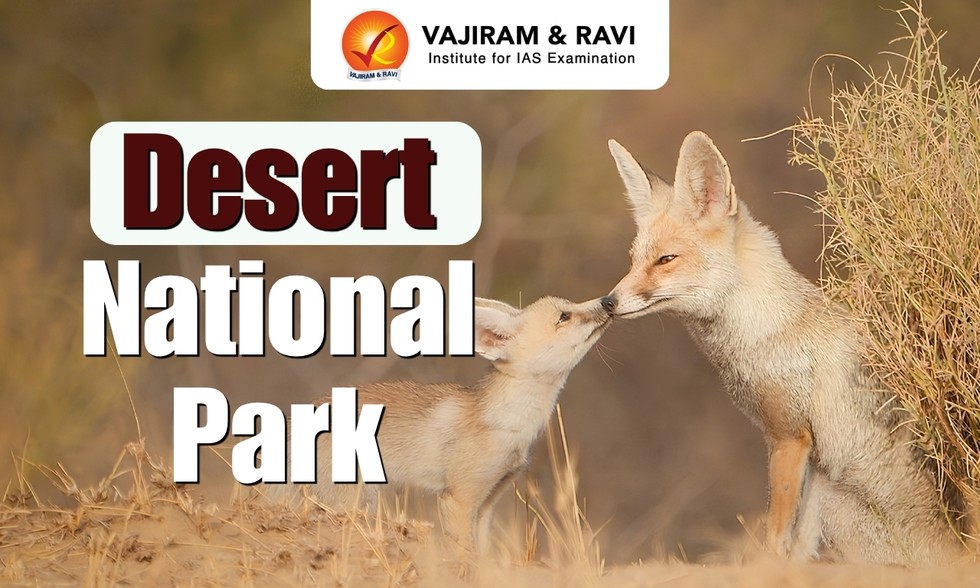
About Desert National Park:
- Location: It is located in the Thar Desert near the town of Jaisalmer, in Rajasthan.
- It is one of the largest national parks in the country.
- Topography: The substantial part of the park is on a landscape, which comprises of lakebed of extinct salt lakes and thorny scrubs and a considerable area consists of sand dunes.
- Climate: The area falls in the extreme hot and arid region of the very low rainfall zone (<100mm) of the country.
- One of the most interesting features of this park is the presence of fossils from the Jurassic Period.
- Vegetation:
- The vegetation of a major part of the arid region of the Thar falls under the thorn forest type.
- The vegetation is quite sparse with open grassland, thorny bushes, plantations and dunes as the broad habitat types.
- Lakes: There are three main lakes in this sanctuary- Rajbaugh Lake, Malik Talao Lake and Padam Talao.
- Flora: It consists of dhok, ronj, salai and palm trees. The vegetation is sparce, and patches of sewan grass and aak shrub can be seen.
- Khejri (Prosopis cineraria) is commonly found, which is revered and protected by the local communities, especially the ‘Bishnois’.
- Fauna: Blackbuck, Chinkara, Desert fox, Bengal Fox, Indian Wolf, Desert Cat, Hare etc. Reptiles are also found in abundance and they include spiny –tailed lizard, monitor lizard, saw scaled-viper, Russel viper , Karit.
- The Great Indian Bustard is one magnificent bird found in relatively fair numbers.